
ECS SRIA 2027
3.3 Digital Industry
On this page
- 3.3.1 Scope
- 3.3.2 Application trends and societal benefits
- 3.3.3 Major Challenges
- 3.3.3.1 Major Challenge 1: Responsive and smart production
- 3.3.3.2 Major Challenge 2: Sustainable production
- 3.3.3.3 Major Challenge 3: Artificial Intelligence in digital industry
- 3.3.3.4 Major Challenge 4: Industrial service business, lifecycles, remote operations and teleoperation
- 3.3.3.5 Major Challenge 5: Digital twins, mixed or augmented reality, telepresence
- 3.3.3.6 Major Challenge 6: Autonomous systems, robotics
- 3.3.4 REQUIREMENT OVERVIEW
- 3.3.5 TIMELINE
The Digital industry chapter highlights the evolution of traditional industry through the introduction of advanced digital technologies in production, management, and distribution processes. These technologies include the Internet of Things (IoT), artificial intelligence (AI), data analytics, co-robotics, 3D printing, and other digital innovations that industry can adopt, including advances in sensing, power, communication, and computing.
Digital industry is characterised by the increasing integration of the physical world with the digital world through the use of data enabled by pervasive digitalisation. This digitalisation brings together heterogeneous topics across the product life cycle, from design to production efficiency and machinery maintenance. It involves all aspects of industrial and business activities, including workers and the working environment.
3.3.1 Scope
To manage machines, factories, and company networks, industry organises the required technologies into levels or technology stacks. In these levels, sensors and actuators are closest to material processing or item handling. Therefore, they are at the lowest level of the Edge-to-Cloud Continuum. Higher levels include supersets, systems of systems, and interconnected IoT devices, unit processes, production or manufacturing lines, operations control, and enterprise business processes. These levels also cover growing numbers of machines, lines, and company boundaries, as manufacturing becomes more networked, complex, dynamic, and global.
Industry 4.0 changes operating modes and strongly affects the management and operation of factories, supply chains, construction sites, and processes. Powerful networked digital tools are required to achieve the situational awareness and control needed for autonomous vehicles, robots, and processes at different autonomy levels. These capabilities support the increasingly pervasive Industry 5.0 approach. Technological tools linked to the decentralised Web 5.0 concept can encompass complex nonhierarchical environments and allow better control of user data.
The European Industry 4.0 and Industry 5.0 transition needs an open-source-based, stable, and extensible semantic internet to overcome user interface, networking, and communication challenges. An internet with smart agents is an overarching concept that includes multiple technologies, such as the industrial Internet of Things, artificial intelligence (AI), advanced data analytics, and augmented and virtual reality (AR/VR). The industrial metaverse, based on digital twins, can be seen as an expanding set of interconnected virtual and augmented worlds. It is accessible from AR/VR head-mounted displays, desktop computers, and mobile phones.
Digital twins created by formalised expert knowledge and the semantics of physics-informed processes allow accurate simulations of manufacturing processes for experimentation and optimisation. Neuromorphic processing is a new computing paradigm that can transform the industrial Internet of Things by replacing traditional power-hungry computing architectures with more energy-efficient brain-inspired systems. These approaches can improve the adoption of increasingly autonomous and environment-aware robotic solutions by generating and fine-tuning synthetic data to explore application scenarios. Entities in the industrial metaverse can include people, devices, and autonomous physical or virtual machines, such as digital twins and AI agents.
The digital transformation of manufacturing processes, software tool creation, data-driven and AI-supported decision-making, and the harmonisation of human-technology relationships enable the next stage of human-robot coworking for Industry 5.0.
This SRIA addresses the digitalisation of major European industrial sectors and promotes European sovereignty within the internal manufacturing ecosystem, together with sustainability and greener industrial processes and artefacts. These sectors include discrete manufacturing, for example automobiles, trains, airplanes, satellites, white goods, furniture, toys, and smartphones. They also include process industries, for example chemical, petrochemical, food, pharmaceutical, pulp and paper, and steel, as well as provisioning, production services, machinery, connected machines, UAVs, and robots. This chapter also emphasises factories, production plants, operating sites, value chains, supply chains, product life cycles, and new materials for structures and electronic components.
Digitalisation is a key enabler for the future success of European industry. This chapter addresses the development potential of responsive, smart, and sustainable production, AI in digital industry, industrial services, digital twins, and autonomous systems. As discussed later in this chapter, nearly all topics in the technology chapters of the SRIA are vital for industrial applications. These topics include standardisation, engineering tools, cybersecurity, and digital platforms. To digitalise European industry and expand and embed the related supply chains, Europe must use potentially all enabling technologies to achieve the required competitive edge. A focus on digital industry also requires the effective use of enabling technologies in industrial applications.
Today, the digital landscape remains fragmented, with significant challenges in standardisation, interoperability, and translation of research into commercial impact. Europe must address these challenges effectively to build a strong, greener, resilient, and responsive economy. Sustainable and human-centric solutions can help Europe achieve strategic autonomy in the future, as outlined in the Draghi Report1 “EU competitiveness: Looking ahead” and in the more sector-specific WMF Report 2024 “New Perspectives for the Future of Manufacturing: Outlook 2030”2.
3.3.2 Application trends and societal benefits
The recent “2030 Digital Decade”3 initiative under Shaping Europe’s Digital Future4 highlights the urgent need for the EU to prioritise action in areas that foster innovation and growth, improve productivity, and mitigate disruptions, particularly in digital technologies and digital skills.
Europe needs industry to become greener, more circular, and more digital while remaining competitive globally. The ecological and digital transitions affect every part of the economy, society, and industry. They require new technologies, supported by investment and innovation. They create new products, services, markets, and business models. They also create new job profiles that require skills that are not yet widely available. In addition, they drive the shift from linear production to a circular economy.
The digital sector also contributes to the European Green Deal, both as a source of clean technology solutions and by reducing its own carbon footprint. Scalability is essential in a digitalised economy. Therefore, strengthening the digital single market supports Europe’s transition. Europe must also accelerate research investment and technology deployment in AI, 5G/6G, and data and metadata management. Private 5G/6G networks are expected to expand in industry, while hybrid clouds enable seamless sharing of content and resources across networks. Web 4.0 smart services and smart things require this evolution through goal-oriented intelligent connection of semantic resources. Connectivity will increasingly link systems and people. Personnel at plant level will become more aware of their operations, and cloud-based artificial knowledge will move closer to devices, sensors, processes, and people. Accuracy can be improved, for example, through hardware-level support for precision time protocol (PTP) in industrial devices. This support can improve indoor localisation through better communication capabilities, such as Bluetooth® Low Energy and ultra-wideband, together with advances in sensors and algorithmic approaches such as time of flight and electrochemical impedance spectroscopy (EIS) for innovative applications.
European factories and machines already have a high level of automation and digitalisation. Many leading end-user companies are based in Europe. Europe also has major system builders, machine builders, engineering companies, and contractors with a competitive edge in automation and digitalisation. However, the business environment is changing. Through specialisation in new or niche end products, production is becoming more demand-driven and agile. At the same time, production is becoming more geographically distributed, which expands supply chains. In addition, the outsourcing of auxiliary business functions such as condition monitoring and maintenance is becoming more common, which leads to highly networked businesses. Industry has many opportunities for optimisation of energy, waste, water, material use, and recycling across value chains and company boundaries. These advantages require a significant increase in digitalisation and the embedding of functions and intelligence in the physical production layer.
This transition should also include applications that do not need to remain internal or confidential. Web-based and cloud-based solutions can support such applications and make them easier for non-AI professionals to use. These solutions can also support offline development of advanced models and inference engines by specialised centres.
The use of AI for core business functions often requires a full redesign of data management, data use, and data tracking across the supply chain. A system-of-systems (SoS) framework can enable effective data capitalisation through suitable actions, especially where conventional analysis and analytical tools reach their limits. Interaction between systems will become more direct. This trend requires more standardised interfaces that enable adaptive connectivity with secure access rights, while some information remains hidden.
The industrial metaverse, based on digital twins, can accelerate employee training and help build the trust required to use intelligent agents. It can enable virtual simulations before construction of physical systems and can speed up research and innovation cycles. It can also support field workers through AR/VR. In addition, it can make worldwide product design collaboration possible. Virtual designs can support physical product creation, and physical items can feed digital assets into digital environments.
Much of the value chain will come from existing installations, because completely new factories are not often built. New fast and secure communication protocols can provide easier connectivity and interoperability across systems and support extensive integration. Secure access to internal networks can provide users with information at any time and from any location within the plant. In addition, cloud-based or edge-based computing systems can provide new features. However, these capabilities require additional hardware infrastructure and greater processing power to handle larger data volumes.
Digital infrastructure and microservices can help evolve business models towards selling added value as a service. Investment in projects can create networks among vendors and providers. In modern business-to-business (B2B) relationships, ongoing R&D and industrial pilots aim to deliver a range of after-sales services to end customers. These services typically include condition monitoring, operation support, spare parts and maintenance services, help desk functions, troubleshooting, operator guidance, performance reporting, advanced big data analytics, prognostics-based decision support, and management information systems.
Industrial services often represent 50% or more of industrial business volume, and this share continues to grow. The share of services is generally higher in high-income countries than in low-income countries. Service businesses are important because they enable sustained revenue after traditional product sales. In many cases, they are also more profitable than the original product sale.
3.3.3 Major Challenges
Each major challenge (MC) focuses on a specific topic. However, all digital industry major challenges interact extensively. Improvements in one MC can support progress in another. Artificial intelligence, robotics, digital twins, and augmented reality often appear together as connected tools that improve industry across many domains.
Six major challenges have been identified for digital industry:
Major Challenge 1: Responsive and smart production.
Major Challenge 2: Sustainable production.
Major Challenge 3: Artificial Intelligence in digital industry.
Major Challenge 4: Industrial service business, lifecycles, remote operations and teleoperation.
Major Challenge 5: Digital twins, mixed or augmented reality, telepresence.
Major Challenge 6: Autonomous systems, collaborative robotics.
3.3.3.1 Major Challenge 1: Responsive and smart production
3.3.3.1.1 Status, vision and selected outcome
Responsiveness, flexibility, and smartness are still largely addressed in the European production landscape through pre-Industry 4.0 automation technology. At the same time, European industry must become much more responsive to change, not only from a scientific and technological perspective, but also in response to critical situations.
Today’s automation solutions are not inherently flexible by design. Industry must apply adaptive and self-learning system principles to automation solutions to improve flexibility, responsiveness, and smartness. Relevant examples include AMR fleets, fleet orchestration, brownfield integration, subscription models, over-the-air management, and secure fleet operations.
Many European initiatives and reports address this topic, including EFFRA5 publications, SMART EUREKA6 mission statements, and ManuFuture7 reports. These initiatives emphasise resilient and adaptive European manufacturing systems that can cope with rapid change, overcome disruptions, and respond to new market needs.
The main benefits of more responsive and resilient production are:
Ability to forecast demand, supply, and the evolution of the competitive ecosystem
Capability to change production and provisioning quickly
Efficiency in high-mix, low-volume production
Capacity to continue operation with reduced operational capability
Ability to support rapid innovation through integration, product evolution, redesign, and process re-engineering
Ability to limit performance, reliability, maintainability, and interoperability degradation when disturbances affect plants.
Chips JU can play a leading role in this evolution towards more responsive, robust, and resilient factories. Responsive and resilient manufacturing has long been a key challenge, from integrated sensors in wearables and prosthetics to systems of systems that enable self-healing and self-reconfiguration.
AI also plays a key role in increasing the flexibility of manufacturing systems. For example, AI applied to real-time scheduling allows production to adapt to rush orders and disturbances in production lines or supply chains. However, the current focus on deep learning should be complemented by other AI approaches that are more explainable and more aware of the environment and the task.
The continuing effects of COVID-19 and current global instability have highlighted why flexible factories must adapt better in times of change. A flexible factory can better support the European response to crises by:
Modifying production according to medical needs and exogenous inputs
Scheduling production with fewer human resources and with social distancing constraints
Enabling agile work and telepresence
Adapting to supply chain changes and promoting European independence through differentiation and more resilient supply chains
Developing local or shorter supply chain capacity for components that normally come from global markets
Developing redesign and re-engineering capacity when raw materials or electronic components are unavailable
Although automation and digitalisation are essential building blocks for a flexible and resilient manufacturing industry, a well-trained and agile workforce remains critical. Workforce agility and flexibility, achieved for example through cross-skilling and empowered by smart technologies such as AR/VR or assistive chatbots, make people indispensable in production processes.
Standardisation is also essential. Modern industrial digitalisation depends on standards because interoperability would not be possible without them. Standards support quality, safety, and reliability in large industrial projects. Many engineering methods are standardised and provide consistency across professional engineering practices. However, these standards must also be supported by appropriate engineering tools for design, development, and operation.
3.3.3.1.2 Key focus areas
Robust and optimal production, scalable first-time-right production: Future manufacturing plants should become more robust and continue production when disturbances occur. This evolution requires advances in self-healing and redundant automation systems, first-time-right and zero-defect manufacturing, and predictive maintenance that supports adaptable production.
Mass customisation and personalised manufacturing, customer-driven manufacturing: Progress towards lot-size-one manufacturing and personalised product design is expected to continue. IoT sensors can self-correct disturbances, real-time warehouse connectivity can optimise the shop floor, and edge devices can run predictive analytics. These advances support greater flexibility.
Resilient and adaptive production, including shorter supply chains and modular and flexible factories: Resilience is a critical property of systems that absorb internal or external stress and adjust their organisation and performance to maintain necessary operations, even with reduced productivity.
Cognitive production: This area combines natural and artificial cognition with IoT devices and data analytics to enable new analytics and learning, event-driven processing, AI processing, in-memory compute evolution, and neuromorphic approaches. These capabilities can support responsive, sustainable and adaptable production.
Manufacturing as a service: Technological advances can expand the geographical distribution of manufacturing and support manufacturing as a service (MaaS). Examples include 3D printing, outsourced production chain elements, and moveable factories. These solutions can support decentralised manufacturing in construction projects or temporary production locations.
Embedded, edge, and cloud architectures: System architectures now commonly include embedded computing near machinery or processes, edge computers or local servers, and cloud computing. 5G technology strengthens edge-to-cloud and edge-to-edge communication and moves workload and services closer to production.
Standardisation: Because of the many existing standards and their installed base, the focus should be on bridging systems across standards. Semantic technologies, software, platforms, digital testing, development environments, and licensing approaches are required to support high-level connectivity and broad acceptance.
3.3.3.2 Major Challenge 2: Sustainable production
3.3.3.2.1 Status, vision and expected outcome
This major challenge focuses on how Industry 4.0 should address future regulations and market requirements linked to the European Green Deal and to zero-carbon or below-carbon-neutral operations.
Nearly 200 countries have committed to the Paris Agreement on climate change, aiming to limit global warming to below 2ºC. Rapid transformation is therefore required across all sectors. Many European countries have set even more ambitious targets. Chips JU can strongly reduce environmental impact through sustainable manufacturing, including energy efficiency, resource efficiency, and circular economy strategies such as eco-design, repair, reuse, refurbishment, remanufacture, recycling, and waste prevention
Some rare earth materials must be preserved, and careless material use can be both uneconomical and harmful to the environment. The vision of Sustainable Process Industry through Resource and Energy Efficiency (SPIRE) translates high-level objectives into practical actions, including more efficient use of energy and resources, waste reduction, reuse of waste streams and energy across sectors, replacement of current feedstock with renewable alternatives, and reinvention of materials and products to improve efficiency across the value chain.
3.3.3.2.2 Key focus areas
Monitoring flows of energy, materials, waste and life cycle assessment: Many industry sectors already require full traceability of material and energy streams. As more products and raw materials become critical, this strategy must expand. Sustainable manufacturing requires comprehensive environmental data and other measurements. IoT sensors, software sensors, virtual sensors, and life cycle assessment (LCA) methods are important tools for this purpose.
Virtual AI assistants: Discharges or losses often occur when production does not proceed as planned because of mistakes, poor machinery condition, or insufficient operator skills. AI-supported assistants can help operators by providing advice, preventing suboptimal changes, and addressing production dynamics.
Human–machine interfaces and machine-to-machine communications: Augmented reality and virtual reality can support many tasks. Improved data visualisation and analytics presentation are required to support decision-making.
Human operators in more autonomous plants and in remote operations: The relationship between machines and people must be reconsidered. This includes touch displays, wearable devices, augmented reality, and retention of the central role of people in new production contexts. Skills 4.0 are required for data administration, privacy, cybersecurity, and more.
Human safety: With localisation of personnel, machines, and vehicles, situation-aware safety becomes increasingly important. Relevant capabilities include safety sensing, proximity detection, online human risk evaluation, and map generation.
Competence and quality of work in human-centred manufacturing: At a strategic level, the European automation and industrial IT industry depends on its Ability to attract skilled personnel to maintain their competence over time. Workers in production and maintenance may require higher levels of formal training, while specialisation continues to increase company-specific training needs.
European Green Deal alignment: All industries must focus on high efficiency, low energy use, carbon neutrality or zero carbon, and zero waste in water, soil, and air. These targets must be measured, calculated, or estimated at product, factory, global and life cycle levels. Industry must also develop new materials while prioritising recycling, reuse, demanufacturing, and remanufacturing.
Many of these advances require development in engineering, business, and social domains beyond the scope of Chips JU. However, electronics and software technologies remain essential to their implementation.
3.3.3.3 Major Challenge 3: Artificial Intelligence in digital industry
3.3.3.3.1 Status, vision and expected outcome
Major Challenge 3 focuses on connected and smarter cyber-physical systems (CPS), industrial internet, big data, machine learning, optimisation, and other AI-based methods. Local edge-based intelligence is a major opportunity for Europe. AI-optimised and open hardware is becoming increasingly important to support the European AI framework.
This major challenge extends towards AI-enabled adaptable and resilient factories, including people as part of a sociotechnical system. AI methods can enhance modern industrial systems, such as predictive condition monitoring, maintenance, scheduling, planning, and quality control. These methods can support reconfigurable first time-right and zero-defect manufacturing, while also supporting human decision-making under uncertainty.
AI-enhanced systems can enable resilient manufacturing ecosystems based on new business models. They can also increase safety and security in working environments, improve productivity, and shorten the return on investment period. Explainable AI (XAI) is an emerging field that supports better understanding of decision-making and therefore improves human trust and system robustness.
Condition monitoring techniques can be applied to many types of industrial components and systems. Their business value often depends on increased equipment availability, better maintenance planning, lower cost, improved on-time delivery, greater safety, and better dimensioning of spare parts and maintenance staff. As a result, condition monitoring can help avoid serious breakdowns and unplanned interruptions.
Another important AI subfield is generative artificial intelligence (GenAI), which uses generative models to produce text, images, video, and other types of data. GenAI is changing digital transformation by changing how companies create, innovate, and interact internally and with customers. It supports generation of personalised marketing content, product descriptions, maintenance documentation, social media content, source code, virtual prototypes, and new digital products and services.
AI affects several main areas relevant to digital industry:
Productivity, by exploiting AI in the design, manufacturing, production and deployment processes through the automation of routine tasks and data-driven analysis.
Flexibility, through AI across the value stream from supply to delivery .
Customer experience, through faster and better-quality products and more efficient services.
Assistance to human operators, through support for decision-making in increasingly complex environments.
Radical innovation, through new products and productivity gains beyond support for existing solutions
These fundamental impacts will be experienced in all areas of every market sector. In manufacturing and production, AI will deliver productivity gains through more efficient resources, energy and material use, better design and manufacturing processes, and in products and services, enhancing their operation with more refined contextual knowledge.
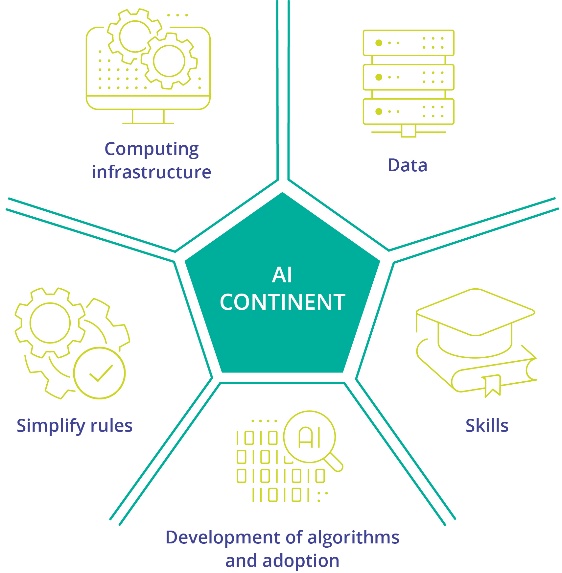
The AI Continent Action Plan8 from April 2025 aims to make the EU a global AI hub and to ensure that AI remains human-centric and trustworthy. The AI Continent Action Plan aims to bring the benefits of AI to various sectors highlighting five strategic areas: (1) computing infrastructure, including AI Factories, AI Gigafactories, Cloud and AI development Act, (2) the Data Union Strategy, improving data access and interoperability, (3) skills or AI talent, by boosting specific education programmes in EU universities, (4) development of algorithms and their adaptation in strategic sectors, and (5) simplifying rules to facilitate the implementation of the AI Act9.
3.3.3.3.2 Key focus areas
European AI framework
Figure 3.3.2 sets out the context for the operation of AI public/private partnerships (PPPs), as well as other PPPs or joint undertakings (JUs). It clusters the primary areas of importance for AI research, innovation and deployment into three overarching areas of interest. The European AI framework: the legal and societal fabric that underpins the impact of AI on stakeholders and users; AI innovation ecosystem enablers: essential ingredients for effective innovation and deployment; and cross-sectoral AI technology enablers: the core technical competencies essential for the development of AI systems.
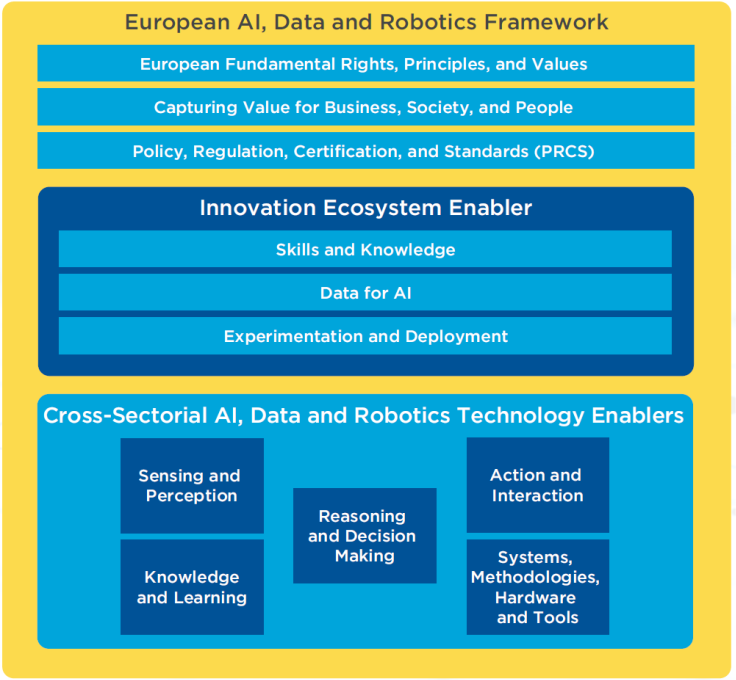
Figure 3.3.2 European AI framework and enablers – SRIDA on AI, Data and Robotics Partnership10
AI in manufacturing
AI for dynamic production planning and management: This involves making real-time decisions to optimise factory operations by quickly modifying the production schedule based on the current state of the shop floor, predicted sales orders, and unexpected events, such as machine breakdowns or changes in job priorities.
Virtual models spanning factory operations and the life cycle: A holistic and coherent virtual model of the factory and its production machinery results from integrating modelling, simulation, and forecasting methods and tools that strategically support manufacturing activities.
AI for green/sustainable manufacturing: The development of software-based decision-support systems, as well as energy and resource management, monitoring, and planning systems, leads to reduced overall energy consumption, more efficient use, and optimised energy sourcing.
AI in supply chain management: Planning and managing logistics for real-time operations, collaborative demand and supply planning, traceability, execution, global state detection, time-to-event transformation, and discrete or continuous query processing are therefore challenging because of the distributed nature of these elements.
AI for advanced manufacturing processes: The ability to design functionality using surface modifications, functional texturing and coatings, enabling improved performance, embedded sensing, adaptive control, self-healing, antibacterial, self-cleaning, ultra-low friction or self-assemblies. For example, using physical approaches (additive manufacturing, laser or other jet technologies, 3D printing, micromachining or photon-based technologies, physical vapor deposition, PVD) or chemical approaches (chemical vapor deposition CVD, sol–gel processes) will deliver high functionality and hence high-value products.
AI for adaptive and smart manufacturing devices, components and machines: Embedded cognitive functions for supporting the use of machinery and robot systems in changing shop floor environments. Open-Hardware-based AI solutions will also support European AI Framework
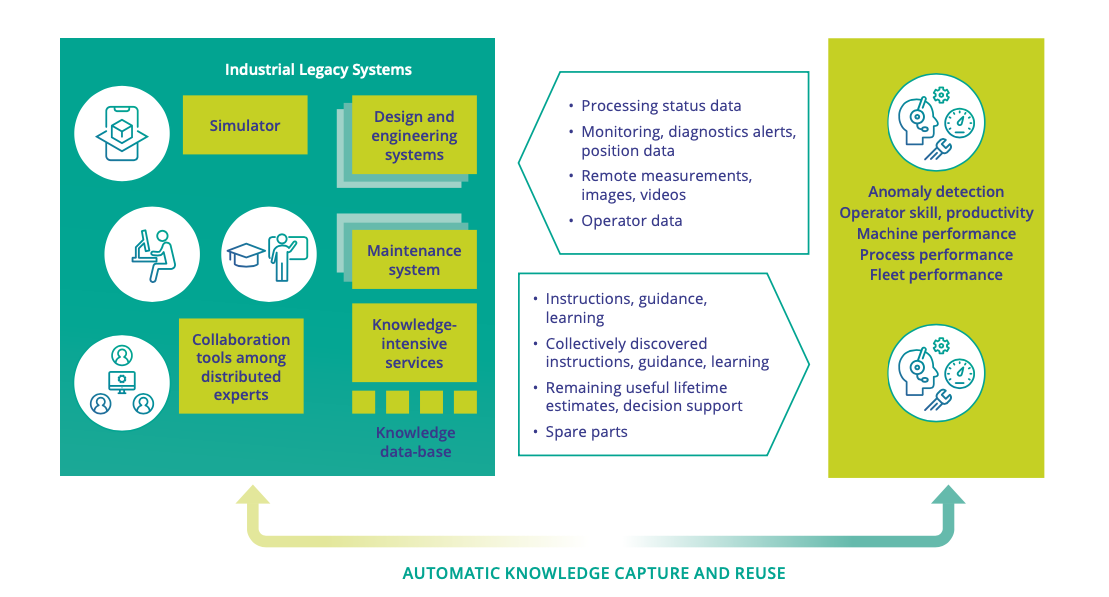
Figure 3.3.3 - Industrial service business between a machine or system vendor or service provider and an end-customer. Services or lifecycle businesses deal with, for example, anomaly detection or condition management, operator skills development, productivity issues, machine or system performances, and fleet performances.
AI for decision-making
Decision-making is at the heart of AI. Furthermore, Explainable AI will increase “human-centric” approaches in autonomous industry.
AI supports complex decision-making processes or helps develop hybrid decision-making technologies.
Human, machine, mixed decision-making and decision support.
Sliding or variable decision-making, dealing with uncertainty.
AI for human interaction with machines.
AI for monitoring and control
AI for control technologies.
AI for monitoring services.
AI for maintenance systems that increase reliability.
AI services for continuous evaluation and mitigation of manufacturing risks.
AI for quality inspection.
3.3.3.4 Major Challenge 4: Industrial service business, lifecycles, remote operations and teleoperation
3.3.3.4.1 Status, vision and expected outcome
The volume and value of industrial services are increasing by 5% to 10% each year. For many machine, systems, and service vendors, the share of services already exceeds the share of machinery sales. This trend affects final assembly factories and supply chain companies alike.
Companies increasingly aim to take larger shares of customer business, starting with spare parts and extending to remote condition monitoring and additional tasks once considered part of the customer core business. From the customer’s perspective, this trend is a form of outsourcing.
Industry as a service changes production by outsourcing local tasks to specialised providers. This approach increases flexibility, resilience, and adaptability in production. It also redefines the supply chain by embedding all production phases, from procurement of raw materials and semifinished products to customer services and product or part design.
While many businesses have become global, some services are still provided locally, close to customers’ locations, while other services are provided centrally by the original vendor or companies specialised in such services. The industrial era is increasingly becoming a service era, enabled by advanced Chips JU technologies. This distributed model fits well with the edge-to-cloud continuum, supported by computing infrastructures for emulation, training, machine learning, and real-time communication.
Service businesses are important because they generate revenue beyond product sales and are typically more profitable than the original product sales. Europe can differentiate in the global service business market through its skilled workforce, deep technology knowledge, and strong ICT capabilities. To succeed, however, Europe needs continued innovation and industrial transformation.
3.3.3.4.2 Key focus areas
Remote operations, teleoperation
Remote engineering, telepresence, and remote operation support
Distributed service applications on edge-cloud systems
Use of low-latency 5G for remote operation
. AI services for monitoring and collaboration
Collaborative product-service engineering and life cycle engineering
Training and simulation
Condition monitoring, condition-based maintenance, anomaly detection, performance monitoring, prediction, and management
Strategic partnerships and data capitalisation, with data as currency, for new service business models
Fleet management, edge and local/global decision-making
Decision and operation support through diagnostics, engineering, and knowledge management
Fleet management based on experience from similar components and machines in different conditions
Business services integration
Local and global services: Organizing services locally close to customers and centrally at vendors’ sites.
Full life cycle tutoring, from operation through end of life, including waste handling, recycling, and redesigning for the next product generation
3.3.3.5 Major Challenge 5: Digital twins, mixed or augmented reality, telepresence
3.3.3.5.1 Status, vision and expected outcome
A digital twin is a dynamic digital representation of an industrial asset that helps companies understand and predict machine behaviour and performance and identify new revenue streams. Cloud connectivity now enables large-scale deployment of digital twin technology across industries. A physical asset can have a virtual copy running in the digital twin environment and can increase value through continuous operational data. Several plants can also operate in the same virtual environment by sharing data and supporting remote automated decision-making.
Digital twins at factory or plant level are becoming increasingly autonomous and intelligent and can adapt through online learning. If needed, they can interact with cloud-level systems to evaluate models and optimise parameters through transfer learning.
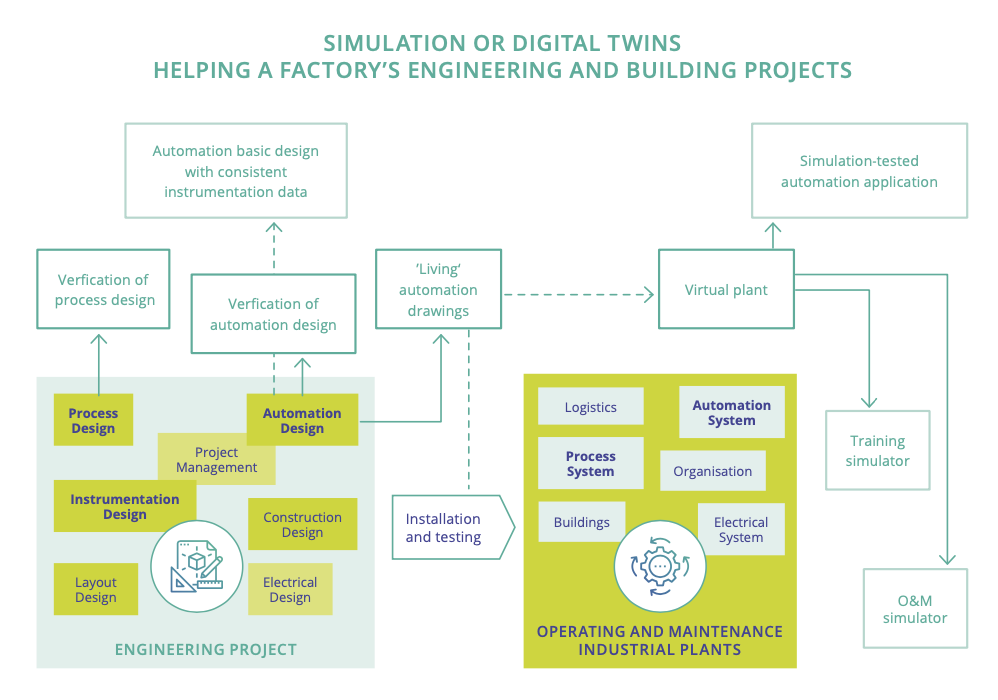
Figure 3.3.4 - Simulation or digital twins helping a factory’s engineering and building projects
Simulation capability is already a key element in the competitiveness of the European machine tool industry. In the Industry 4.0 paradigm, modelling plays a central role in managing technological complexity. A holistic engineering approach is required to span disciplines and provide end-to-end engineering across the entire value chain. Modelling and simulation can also address many digitalisation challenges. They can visualise real-world phenomena, support design optimisation and safety analysis, assess changes in advance in virtual domains, support training with synthetic data, and shift digitalisation focus from computer-aided design to simulation-based design.
In addition to virtual commissioning, modelling and simulation can offer versatile environments for training operators and users, capable of generating the synthetic data necessary for the development of increasingly sophisticated robotic implementations, such as the adoption of autonomous (humanoid) robots in unstructured environments within production areas.
Simulators can be used online and in parallel with real systems to predict behaviour, provide early warnings, and outline decision scenarios. Although simulator technology has long research roots, current simulators still need co-design and further improvement, including use of recent European investments in computing infrastructure (e.g. HPC EU families, EPI initiative), with a special focus on the industrial context.
Telepresence technologies can also be considered predecessors of extended reality (XR) presence. The combination of XR, AIoT, edge computing, high-performance computing (HPC), 5G, and open integration platforms offers major innovation potential for European digital industry.
As an example, XR is a combination of virtual and augmented reality, and XR presence is a continuum between a physical reality presence and a virtual reality presence. The industrial applications have followed the prospects offered by the gaming industry and consumer applications. One of the reasons for its increased take-up is the declining cost of electronic components and sensors. Smart glasses and related platforms can support industrial use cases and can connect to services such as digital twins and condition monitoring systems. These services can optimise operations and provide critical information to field workers. Longer-term integration of human actions and data can also support knowledge graphs that help other users work with expert-level knowledge.
The EC "Data Act" initiative11 promotes reliable and secure access to data within the European data economy and supports the digital transformation and data sharing and exchange. In industrial applications and in interoperability across different legal entities, data ownership and use must be managed properly.
3.3.3.5.2 Key focus areas
Digital Twin: Design process digitalisation, telepresence
Interoperability across heterogeneous systems
Immersive telepresence for industrial robotics
Digital twins for sustainability and circular economy analysis
Virtual commissioning, interoperability:
Virtual commissioning across different domains of engineering (mechanic, electronic, automation) in the same environment.
Adequate interoperability must ensure the use of applications across different platforms.
Simulators: tracking and simulator-based design
Tracking mode simulation: Model adaptation based on measurements. Automatically generating simulators from other design documentation and measurementss, etc.
Simulator-based design: Testing the designed model by replacing the required physical components with their virtual models. This offers continuous design improvement (the digital twin provides feedback and knowledge gained from operational data), design optimisation, etc.
Digital twins combined with data-driven models (knowledge and data fusion):
Combination of data-driven and knowledge-based models along the complete lifecycle (product and production).
New methods to generate large 3D scenes, for example, on NeRF (Near Radial Field) and/or the Gaussian Splats.
Human and knowledge integration:
Human-in-the-loop simulations: Methods and simulations for human-in-the-loop simulations and integration of digital twins in learning systems for workers.
The 3D Internet platform: to integrate all of the aforementioned aspects into a single powerful networked simulation to provide the Situational Awareness for an industrial process as a whole.
Live 3D Digital Twins: to provide the state awareness (animation, colour, etc.) in AR/VR/XR.
3.3.3.6 Major Challenge 6: Autonomous systems, robotics
3.3.3.6.1 Status, vision and expected outcome
Machines are typically more precise and efficient than people in repeatable tasks. Therefore, replacing or supporting work processes that are prone to human error, quality defects, or safety issues can improve quality and reduce waste. AI in robotics, and robotics without AI, expands the opportunities for automation of manual tasks and can increase sustainability, safety, security, and support for the green transition. This evolution can reduce environmental impact, reduce waste efficiently, optimise product quality towards zero defects, and improve processes and workforce support. It can also create safer and more secure work areas for human-machine and machine-machine coworking. Progress in physical AI and robot foundation models allows robots to understand their surroundings and autonomously perform and learn complex physical tasks through natural language.
Autonomous systems, robots, and working machines cover many domains, including industrial machines and robots, consumer robots, healthcare and medical robots, moving machines, transport systems, and utilities and critical infrastructures.
The main goals and trends for robots and autonomous systems in digital industry are:
Production efficiency, speed and reduced costs,
Higher precision and quality, safety in working conditions,
Scaling up “smart and high-end manufacturing”.
These goals highlight the strategic need for complete general-purpose industrial robot platforms and for a transition of advanced and anthropomorphic robot solutions from research laboratories to serial production and integration in production plants. Strategic sovereignty in AI robotics must grow with advances across the full robot stack, including actuators, hands, sensors, batteries, safety controllers, communication, AI, middleware, and production scaling.
Robots, machines, and autonomous systems are relevant across all application chapters of this SRIA, not only digital industry. They also affect digital society, health and well-being, mobility, energy, and agrifood and natural resources, and they benefit from advances in foundational and cross-sectorial technologies.
There is a clear move towards higher automation and digitalisation in industry, including robotic solutions with anthropomorphic and humanoid forms based on advanced AI cognitive platforms. In these solutions, mechanics, sensor advances, tactile skin, multimodal end effectors, compliant actuation, manipulation benchmarks, and AI work together to support multimodal perception, learning from experience, real-time prediction, and adaptive decision-making beyond traditional solutions.
However, between fully manual and fully autonomous manufacturing, there will always be a wide range of semiautonomous equipment, machines, vehicles, lines, factories, and sites. In many cases, it remains beneficial to stay below full autonomy or full digitalisation because full autonomy can be technically very difficult, very expensive, overly complex, brittle, or unsafe. A semiautomatic solution can often be easier to implement at a satisfactory level.
When automation and digitalisation increase gradually and professionally, they can provide major competitive advantages and savings. Because the degree of automation often remains well below 100%, negative employment effects can remain negligible or absent. On the contrary, broader adoption of robotics and autonomous systems can strengthen company market positions and increase demand for people in related businesses. Work organisation and leadership may need to evolve to unlock the full potential of digital industry.
3.3.3.6.2 Key focus areas
Autonomous functions of systems:
Advances in AI simplify the development of autonomous systems that automate work tasks in many domains, reduce the need for human intervention, and enable innovative new functions. Autonomous robotics is a key enabling technology for autonomously operating shop floors. This includes humanoid and anthropomorphic robots, robotic arms and end effectors, and autonomous mobile robots. Benefits include additional safety, increased productivity, improved accessibility, higher efficiency, and positive environmental impact. The following figure provides a generalised view of technologies and functionalities used in autonomous systems developed in the automotive domain. Nevertheless, this schematic representation of required building blocks can be generalised to many other types of autonomous systems.
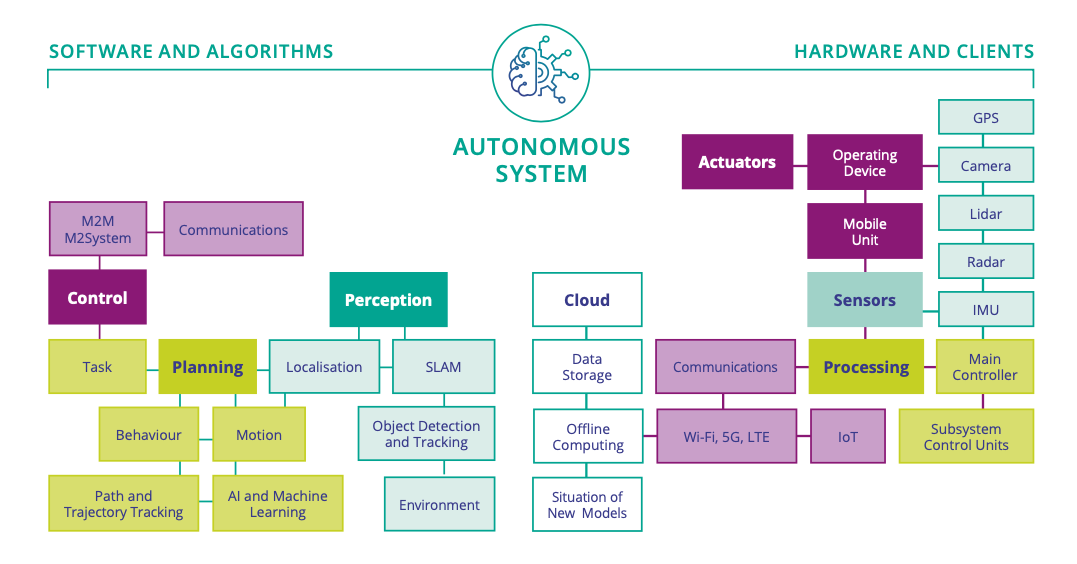
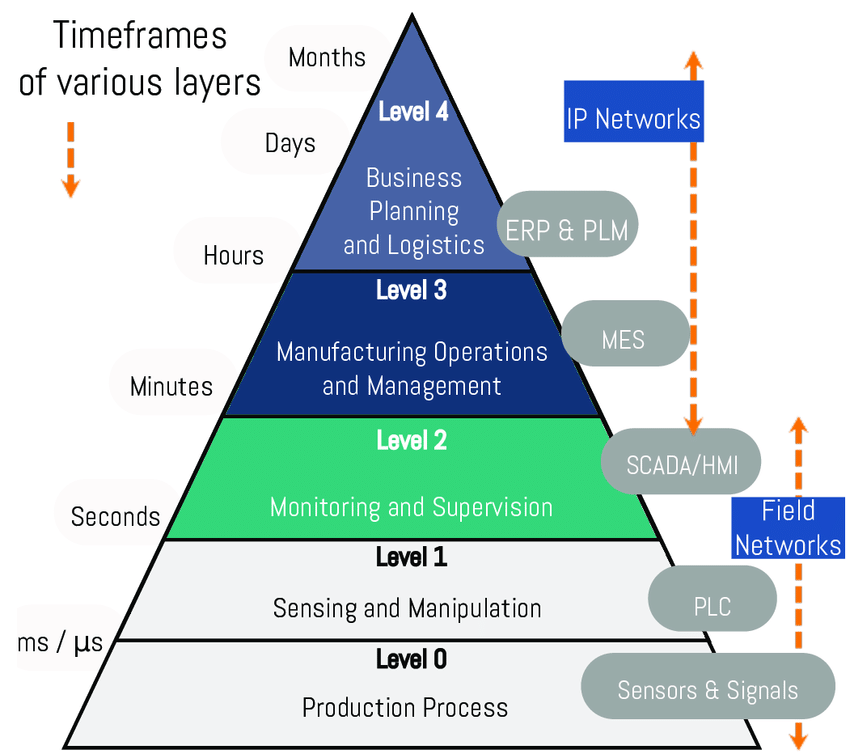
The following figure shows how the ISA95 standard, which defines control and other enterprise functions, maps onto the building blocks of autonomous systems. Autonomy is expected to increase at Levels 2 and 3 of ANSI/ISA9512.
Safety and security in autonomous systems:
Current safety approaches for autonomous machines include:
On-board sensors and safety systems for machines that operate near people and other machines in indoor environments
Isolated autonomous machines that work in separate areas, mostly in intensive outdoor environments where other machines or humans are monitored.
Machine perception and prediction of expected and/or unexpected human activities to assist people, preserve health and safety, and protect machinery.
Operator responsibility transfer, with sufficient warning time, for reacting to a hazardous situation encountered by an autonomous machine.
Advanced robot integration in industry also requires new focus on robot data, simulation-to-real methods, and certification of learned robot behaviour, including dataset handling, test environments, field data augmentation, robot policy validation, and failure mode discovery.
Requirements management and conceptual modelling of autonomous systems:
Increasing autonomous functionality makes traditional safety-critical software development methods less adequate. Autonomous systems must operate in complex real-world environments and react correctly to a nearly endless variety of scenarios. Their design must consider expectations from various stakeholders such as the internal engineering teams, people involved in the autonomous systems management (e.g. passengers, drivers, workers, e-Health patients), regulatory authorities, and commercial autonomous vehicle/robot fleet operators.
Human–machine interaction in autonomous systems:
Advances in sensing, actuation control, industrial IoT, and SoS distributed capability are key enablers for:
Human-robot interaction or human-machine cooperation.
Transparency of operations between human and Advanced Machine Systems (AMS) in uncertain conditions.
Remote operation and advanced perception, autonomous system oversight and tactical awareness.
Autonomy that enhances human capabilities.
Natural human interaction with autonomous systems.
Assisted, safety-oriented and proactive robot interaction with people.
Digital design practices including digital verification and validation (V&V):
Automatic or semi-automatic Verification & Validation.
Digital design environment, digital twins and physical mock-ups.
Sub-task automation development, generation of training data and testing solutions and field data augmentation.
Machine state estimation based on system measurements.
Simulators and autonomous systems:
Process-model-based and product-3D-model-based approaches,
Environment and object models.
Early design phase simulators.
Robotic test environments.
Empirical and semi-empirical simulators based on real and simulated data.
Off-road environments.
Autonomous capabilities development in a digital environment
Autonomous decision-making.
Self-evolving capabilities.
Use of knowledge for cognitive flexibility and adaptive reactions.
Edge AI in robotics with applications focused on manufacturing and automation
3.3.4 REQUIREMENT OVERVIEW
The most obvious requirement for digital industry is the availability of the technologies, components, and systems described in other parts of this document, both as foundational technologies and as cross-sectorial areas that enable the European digital industry mission.
It is also extremely important to meet several societal and policy needs, particularly the following aspects of EU legislation related to working environments:
Adoption of trustworthy, responsible AI, extended reality and robotics.
Preparation for the use of next-generation hardware architectures and new chip design, for example RISC-V.
Adoption of technologies that safeguard worker safety and security.
The following policy aspects must also be considered to promote:
Resilience of EU production capabilities and supply chains for industrial sovereignty.
Sustainability of EU manufacturing renovation and evolution towards a greener and safer EU.
Digitalisation of EU Industry towards faster Innovation vocation, cost-efficient production, lower energy consumption and improved ability to forecast market and societal needs .
3.3.5 TIMELINE
| Major Challenge | Topic | Short term (2027–2031) | Medium term (2032–2036) | Long term (2037 and beyond) |
|---|---|---|---|---|
| Major challenge 1: Responsive and smart production | Topic 1.1: Robust and optimal production, scalable first-time-right production | Disturbance-tolerant production demonstrated with fault detection, safe degraded operation and measured quality/yield. | Reconfigurable lines qualified against representative failures with verified recovery and controlled quality feedback. | Cross-site production adaptation qualified under supply disruption with independent quality and continuity evidence. |
| Topic 1.2: Mass customisation and personalised manufacturing, customer-driven manufacturing | Lot-size-one production workflows demonstrated with traceable configuration, setup time and quality evidence. | Mass-customisation platforms qualified across product variants with coordinated planning and validated changeovers. | Distributed personalised production qualified across suppliers with maintained configuration and product-quality assurance. | |
| Topic 1.3: Resilient and adaptive production, including the shortening of supply chains and modular and flexible factories | Brownfield AMR fleets and modular production cells demonstrated with secure orchestration, OTA updates and recovery. | Reconfigurable factory modules qualified across suppliers and changing production tasks. | Cross-site modular manufacturing qualified under component shortages with traceable substitution and continuity. | |
| Topic 1.4: Cognitive production | Cognitive production pilots demonstrate AI-assisted planning and operator decisions with measured benefits and bounded actions. | Closed-loop cognitive production qualified for selected processes with monitored drift and safe fallback. | Federated cognitive operations qualified across plants with controlled adaptation and independent performance evidence. | |
| Topic 1.5: Manufacturing as a service | Manufacturing-service platforms demonstrated with secure capacity discovery, order traceability and measured service performance. | Distributed production services qualified across suppliers with verified quality, scheduling and data rights. | Reconfigurable service ecosystems qualified under cross-border disruptions with controlled process transfer and recovery. | |
| Topic 1.6: Embedded/Edge/Cloud architectures | Private-5G industrial edge/cloud platforms demonstrated with bounded latency, local fallback and secure workload placement. | Interoperable edge-cloud orchestration qualified for critical production; 6G adoption conditional on products and allocations. | Cross-operator workload migration qualified under changing networks with maintained real-time, safety and security evidence. | |
| Topic 1.7: Standardisation | Conformance-tested OPC UA, Asset Administration Shell (AAS) submodels and fleet-interface profiles demonstrated in heterogeneous brownfield plants, with manufacturing-data-space exchange. | Cross-standard semantic and data-space integration qualified with versioned models, governed cross-company exchange, conformance tests and controlled migration. | Lifecycle interoperability qualified across successive standards and independently maintained production systems. | |
| Major challenge 2: Sustainable production | Topic 2.1: Monitoring flows of energy, materials, waste and life cycle assessment | Operational energy/material monitoring demonstrated with calibrated sensors, Digital Product Passport-ready identifiers, traceable product data and auditable lifecycle calculations. | Cross-site resource optimisation qualified with verified data provenance, interoperable environmental reporting and measured reductions. | Value-chain resource orchestration qualified with independent lifecycle benefit and circularity evidence. |
| Topic 2.2: Virtual AI assistants | Industrial AI assistants demonstrated on operator tasks with verified answers, protected data and human approval. | Context-aware assistants qualified across sites with measured error reduction and controlled tool access. | Lifecycle support agents qualified under changing products and procedures with auditable knowledge and maintained operator authority. | |
| Topic 2.3: Human–machine interfaces and machine-to-machine communications | Multimodal HMI and machine interfaces demonstrated with measured usability, workload and accessible alternatives. | Interoperable XR decision support qualified for real production tasks with validated information and user control. | Adaptive interfaces qualified across changing roles and abilities with sustained task-performance and safety evidence. | |
| Topic 2.4: Human operators in more autonomous plants and in remote operations | Teleoperation and assistive robotics demonstrated with tested handover, cyber protection and operator workload limits. | Human-robot workspaces qualified for selected collaborative tasks with validated safety and responsibility allocation. | Adaptive human-robot teams qualified across changing tasks with verified intervention and lifecycle safety evidence. | |
| Topic 2.5: Human safety | Personnel/vehicle localisation and proximity safety demonstrated with measured coverage, confidence and fail-safe behaviour. | Context-aware protective functions qualified against occlusion, localisation faults and foreseeable human behaviour. | Coordinated workspace protection qualified under changing layouts with independently assessed residual risk. | |
| Topic 2.6: Competence and quality of work in human-centred manufacturing | XR/AI-supported industrial training demonstrated with measured competence transfer, accessibility and worker participation. | Reusable training and task-support systems qualified across sites with sustained skills and workload evidence. | Lifecycle competence-support platforms qualified under changing automation with independent evidence of work quality and effective oversight. | |
| Topic 2.7: Green Deal | Resource-efficient production and circularity workflows demonstrated with auditable energy, material and emissions baselines. | Repair, remanufacturing and recovery systems qualified with traceable product data and measured lifecycle benefits. | Cross-value-chain circular production qualified with independently assessed resource savings; climate policy targets remain external constraints. | |
| Major challenge 3: Artificial Intelligence in digital industry | Topic 3.1: European AI framework | European industrial-AI deployment toolchains demonstrated with reproducible evaluation, representative data and traceable governance. | Reusable AI qualification workflows validated across industrial domains with monitored operating assumptions. | Sustained cross-sector AI ecosystems qualified through transferable evidence and controlled lifecycle change. |
| Topic 3.2: AI in manufacturing | AI planning, inspection and maintenance integrated in operational pilots with measured production, quality and resource benefits. | Vertical and horizontal AI workflows qualified across business and shop-floor systems with bounded closed-loop actions. | Adaptive production coordination qualified across suppliers with verified stability, resilience and human authority. | |
| Topic 3.3: AI for decision-making | Explainable decision support validated against operator tasks with confidence information and explicit escalation. | Mixed human/AI decision workflows qualified under uncertainty with auditable allocation of authority. | Adaptive decision coordination qualified across sites with sustained oversight and independently assessed operational outcomes. | |
| Topic 3.4: AI for monitoring and control | AI monitoring/control demonstrated with measured false alarms, drift detection and safe fallback, including GNSS-denied environments. | Adaptive control qualified for selected industrial processes with physical validation and monitored model limits. | Cross-process autonomous optimisation qualified with bounded control authority and independent stability/recovery evidence. | |
| Major challenge 4: Industrial service business, lifecycles, remote operations, and teleoperation. | Topic 4.1: Remote operations, teleoperation | Secure remote operation demonstrated with verified latency, operator handover and safe response to communication loss. | Distributed remote services qualified across sites with measured availability, access control and recovery. | Cross-operator remote operations qualified for selected tasks with sustained safety and accountability evidence. |
| Topic 4.2: AI services for monitoring and collaboration | AI-based monitoring and collaborative services demonstrated with validated diagnostics and governed lifecycle data exchange. | Cross-site maintenance services qualified with uncertainty-aware forecasts and measured availability benefits. | Federated lifecycle services qualified across suppliers with transferable models and independently verified service performance. | |
| Topic 4.3: Fleet management, edge and local/global decision-making | Mixed AMR fleet orchestration demonstrated using VDA 5050 profiles, conformance tests and local collision protection. | Cross-vendor fleet management qualified under congestion, network failure and changing production routes. | Multi-site fleet coordination qualified with governed local/global decisions and independently tested recovery. | |
| Topic 4.4: Business services integration | Production/business service integration demonstrated with versioned interfaces, data-space identity and usage control, and measurable customer outcomes. | Lifecycle service orchestration qualified across vendor and customer systems with traceable knowledge updates. | Cross-organisational product-service ecosystems qualified through successive product generations and controlled evidence exchange. | |
| Major challenge 5: Digital twins, mixed or augmented reality, telepresence | Topic 5.1: Digital Twin: Design process digitalisation, telepresence | Operational digital twins and telepresence demonstrated with verified interfaces, model fidelity and measured task benefits. | Interoperable twins qualified across production and lifecycle services with validated circularity and telepresence use cases. | Federated twins qualified across suppliers with synchronisation, uncertainty and controlled lifecycle evolution. |
| Topic 5.2: Virtual commissioning, interoperability | Virtual commissioning demonstrated across mechanical, electrical and automation models with physical correlation. | Cross-platform commissioning qualified through conformance tests and controlled model/interface versions. | Reusable commissioning ecosystems qualified across successive production generations with independent evidence continuity. | |
| Topic 5.3: Simulators: tracking and simulator-based design | Measurement-calibrated simulators demonstrated for design changes with quantified fidelity and uncertainty. | Simulator-assisted plant reconfiguration qualified with verified interfaces and retained physical acceptance tests. | Lifecycle simulator generation qualified across changing plants with monitored validity and independent calibration. | |
| Topic 5.4: Digital twins combined with data-driven models (knowledge and data fusion) | Hybrid physics/data twins demonstrated with traceable training data and measured predictive validity. | Hybrid twins qualified for selected processes with drift monitoring and verified synthetic-scene transfer. | Adaptive hybrid-twin federation qualified across sites with bounded uncertainty and maintained physical evidence. | |
| Topic 5.5: Human and knowledge integration | Human-in-the-loop XR/twin workflows demonstrated with validated task performance, workload and safe collaboration. | Collaborative knowledge/twin services qualified across sites with provenance and effective operator control. | Adaptive shared workspaces qualified over lifecycle changes with sustained competence and human-safety evidence. | |
| Major challenge 6: Autonomous systems, collaborative robotics | Topic 6.1: Autonomous functions of systems | Task-bounded autonomous robots, including humanoid pilots, demonstrated with measured reliability, energy use and safe intervention. | Multi-task robot cells qualified within defined operating envelopes with tested failure handling. | Adaptive robot teams qualified across changing production tasks with independent safety, uptime and lifecycle evidence. |
| Topic 6.2: Safety and security in autonomous systems | Robot perception and protective functions demonstrated with measured coverage, fault handling and safe human interaction. | Collaborative robot applications qualified under defined hazards, cyber threats and supervision arrangements, including post-update safety and cybersecurity reassessment. | Evolving robot workspaces qualified with compositional safety/security evidence and controlled behavioural updates. | |
| Topic 6.3: Requirements management and conceptual modelling of autonomous systems | Stakeholder requirements and operating envelopes translated into traceable autonomous-system models and scenario tests. | Requirements/toolchains qualified for controlled changes with explicit scenario-coverage and residual-risk evidence. | Lifecycle requirements assurance qualified across changing compositions without claims of exhaustive real-world scenario coverage. | |
| Topic 6.4: Human–machine interaction in autonomous systems | Natural-language/gesture robot programming and haptic teleoperation demonstrated with verified commands and safe fallback. | Multimodal robot interaction qualified across representative users and production tasks with measured intervention performance. | Adaptive human-robot cooperation qualified under changing tasks with sustained usability, authority and safety evidence. | |
| Topic 6.5: Digital design practices including digital verification and validation (V&V) | Digital V&V pipelines demonstrated using traceable scenarios, synthetic/field data and physically correlated twins. | Simulation-led robot qualification validated for selected tasks with coverage metrics and retained physical tests. | Continuous robot V&V qualified for restricted updates with independently assessed behavioural change and evidence continuity. | |
| Topic 6.6: Simulators and autonomous systems | Robot simulators demonstrated with representative environments and measured simulation-to-real transfer. | Reusable test environments qualified across robot types with calibrated physics and validated synthetic data. | Adaptive simulation ecosystems qualified through sustained field feedback and independently quantified model limits. | |
| Topic 6.7: Autonomous capabilities development in a digital environment | Digital robot-policy development demonstrated with reproducible training, safe deployment gates and bounded edge execution. | Adaptive robot skills qualified within monitored envelopes with rollback and verified policy transfer. | Controlled skill adaptation qualified across robot generations with independent assurance and sustained field reliability. |
https://commission.europa.eu/topics/strengthening-european-competitiveness/eu-competitiveness-looking-ahead_en↩︎
https://www.effra.eu/news/wmf-report-2024-new-perspectives-for-the-future-of-manufacturing-outlook-2030↩︎
https://digital-strategy.ec.europa.eu/en/policies/europes-digital-decade↩︎
https://commission.europa.eu/system/files/2020-02/communication-shaping-europes-digital-future-feb2020_en_4.pdf↩︎
https://www.effra.eu↩︎
https://www.smarteureka.com/about-us/mission-vision/↩︎
http://www.manufuture.org/wp-content/uploads/Manufuture-Vision-2030_DIGITAL.pdf↩︎
https://digital-strategy.ec.europa.eu/en/factpages/ai-continent-action-plan↩︎
https://digital-strategy.ec.europa.eu/en/policies/regulatory-framework-ai↩︎
https://bdva.eu/download/92/publications/3122/ai-data-and-robotics-sirda-joint-version-rel3-1.pdf↩︎
https://digital-strategy.ec.europa.eu/en/policies/data-act↩︎
https://www.isa.org/standards-and-publications/isa-standards/isa-standards-committees/isa95↩︎
https://www.researchgate.net/figure/The-conventional-automation-pyramid-according-to-the-ANSI-ISA-95-model-The-five_fig1_343473533↩︎