
ECS SRIA 2027
Executive Summary
ECS Research and Innovation in Europe’s Strategic Framework
We are living in a period characterised by unprecedented challenges: trade and geopolitical tensions, climate crisis, ageing population, supply-chain vulnerabilities, cyber and security risks, and rapid technological disruption, to name a few. Electronic Components and Systems (ECS) bear the promise to be key tools to allow us to overcome many of the aforementioned challenges. Faced with a flurry of possible technology options, and limited financial and human resources, Europe needs to make sure that it aligns its research efforts and public support where it can best leverage its strengths and mitigate its weaknesses, both now and in the future. This is the purpose of this ECS Strategic Research and Innovation Agenda (ECS SRIA), jointly developed by experts of the European ECS community and coordinated by the three industry associations AENEAS, INSIDE and EPoSS.
Long-standing priorities such as competitiveness, sustainability and digital sovereignty have been further refined by taking into account resilience, strategic autonomy, economic security and European AI capacity. This tenth edition identifies the Major Challenges, necessary research, development and innovation (RD&I) efforts and expected outcomes. The technology domains range from micro- and nanoelectronics and electronics system integration through embedded and cyber-physical systems to complex systems-of-systems. The SRIA provides a common technical agenda for strengthening Europe’s industrial base and for enabling value, growth, jobs and prosperity.
Against this background, ECS is not merely one industrial sector among others, but a foundational enabling layer for Europe’s strategic agenda. As the SRIA Introduction makes clear, ECS underpins mass applications, industrial value chains and the digitalisation of society. Its five objectives closely mirror the Union’s current priorities:
Objective 1: Boost industrial competitiveness through interdisciplinary technology innovations.
Objective 2: Ensure EU digital autonomy through secure, safe and reliable ECS supporting key European application domains.
Objective 3: Establish and strengthen sustainable and resilient ECS value chains.
Objective 4: Unleash the full potential of intelligent and autonomous ECS-based systems.
Objective 5: Enable the ECS Engineering Ecosystem.
The first four objectives define the strategic outcomes. The fifth is the engineering basis needed to achieve them. Sovereignty, resilience and competitiveness depend not only on inventing technologies, but also on Europe’s ability to engineer, validate, deploy, operate and continuously improve complex ECS-based systems across their lifecycle.
Europe’s ECS policy framework has moved further from strategic orientation towards industrial implementation. The first European Chips Act created the framework for advanced design capacities, pilot lines, competence centres and stronger links from research to industrialisation. The proposed Chips Act 2.0 extends this approach by strengthening the connection between semiconductor development, industrial demand, investment and supply-chain resilience. The 2026 European Technological Sovereignty Package broadens the policy context further through the proposed Cloud and AI Development Act, the EU Open Source Strategy and the Strategic Roadmap for Digitalisation and AI in Energy. The scope therefore reaches from semiconductors to the computing, cloud, software and energy capabilities needed for European digital sovereignty and AI capacity.
The proposed Horizon Europe programme for 2028–2034 and the European Competitiveness Fund reinforce the same direction by connecting research more closely to industrial scale-up and deployment. The role of the SRIA remains very relevant in this new setup. It is funding-programme-agnostic and identifies the research and technology capabilities that Europe needs to master. Funding, capacity-building and market instruments provide routes towards industrialisation and uptake. The SRIA can therefore provide a common technical basis across changing European programmes and implementation mechanisms.
Achieving these objectives is also directly in the interest of European ECS players. The global semiconductor market reached USD 795.6 billion in 2025 and is forecast to rise to USD 975.5 billion in 2026. Electronic components are in turn the basis for a much broader electro and digital goods market. In Europe, this translates into a large and strategically relevant industrial base. For research organisations and universities, the opportunity is different but equally important: stronger demand for collaborative research and technology transfer, access to pilot lines and industrial infrastructures, and a growing role in educating the skilled workforce needed for European competitiveness and technological leadership.
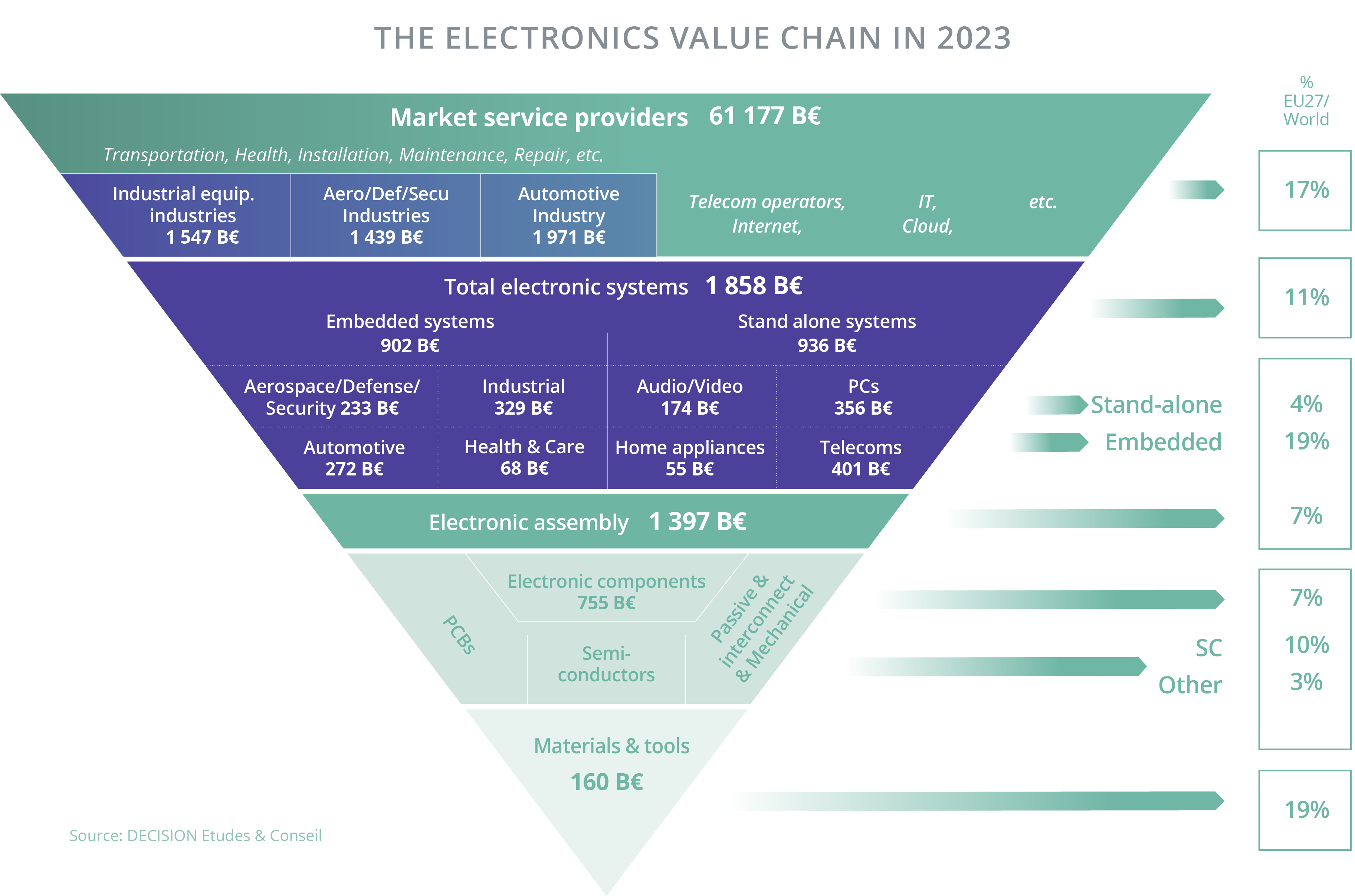
The SRIA is updated annually to reflect technological, industrial and geopolitical change. The 2027 edition therefore introduces changes across all chapters.
Overview of current topics of the SRIA
For the next ten years, the ECS agenda is shaped by trends that open new architectural options, reduce strategic dependencies or create new performance envelopes. Some of these trends are briefly introduced below: Chiplets, open-source hardware, quantum technologies, spintronics, photonics, artificial intelligence, and energy efficiency.
Chiplets break large integrated circuits into reusable functional blocks. They allow each block to be fabricated in the process technology best suited to its function and can improve yield, shorten time-to-market and reduce cost. For Europe, they are particularly relevant where advanced packaging, heterogeneous integration, memory proximity and die-to-die interoperability can become differentiators for AI, high-performance computing and application-specific systems.
Open-source hardware plays a different strategic role. RISC-V and related open architectures can lower barriers to innovative system design and reduce dependence on proprietary processor intellectual property. Their strategic value depends on an industrial ecosystem around them: governance, documentation, verification, certification, engineering tools, maintenance and long-term lifecycle support. The EU Open Source Strategy gives this issue additional policy relevance. For the SRIA, the objective are therefore open technologies that can be used reliably in industrial, automotive and other demanding ECS applications.
Quantum technologies are strategically important because market positions are not yet fixed. Europe therefore still has an opportunity to build leadership. The challenge covers both quantum chips and the classical electronics needed to industrialise and scale them. The main modalities require specific materials, process technologies, metrology, qubit fabrication, control and read-out, and in many cases cryogenic interfaces. Quantum sensing is already relevant for applications such as timing and navigation, while quantum computing is expected to have the largest long-term market impact.
Spintronics belongs to the same disruptive category. Beyond already-commercial magnetic random-access memory (MRAM), it offers a path towards ultra-low-power processing, sensing and storage and can contribute to neuromorphic and unconventional computing. Europe enters this field with strong research capabilities.
Photonics is driven by the bandwidth and energy limits of copper interconnects in data centres and high-performance computing. Silicon photonics offers complementary metal-oxide-semiconductor (CMOS) compatibility, small size, low power and high-speed transmission. Full functionality, however, requires integration with additional materials for light sources, modulation and specialised wavelength ranges. Photonics is therefore also an integration challenge spanning data communications, chip-to-chip interconnects, sensing, quantum systems and biomedical or environmental applications.
Artificial Intelligence (AI) has two closely connected roles in the ECS agenda. First, ECS must provide the computing infrastructure for AI. Edge and embedded processing move intelligence closer to sensors and actuators, reducing latency, communication and data movement while improving privacy and resilience. The scope is expanding from embedded inference towards generative and agentic AI and Physical AI. This creates new requirements for energy-efficient accelerators, memory architectures, sensing, real-time software and trustworthy interaction with the physical world.
Second, AI is becoming an engineering technology for ECS itself. It supports architecture exploration, design-space optimisation, software engineering, verification and validation (V&V), test generation and operation. This makes European AI capacity dependent on more than large data-centre infrastructure. It also requires efficient processors and memories, high-bandwidth interconnects, embedded computing platforms and engineering methods across the cloud-edge continuum. AI also increases system complexity, making suitable training data, explainability, validation and trustworthiness integral parts of the engineering challenge.
A further shift concerns the lifecycle of ECS. Software-defined, connected and AI-enabled systems continue to change after deployment. Engineering therefore has to connect design, verification, operation and later updates rather than treating market introduction as the end of development. Digital threads and twins, component provenance, secure updates, virtual validation and continuous assurance provide the technical basis for this lifecycle approach. They connect competitiveness with resilience and trustworthiness: Complex systems can only evolve at industrial speed if changes remain traceable, verifiable and certifiable.
Managing energy demand is another first-order ECS topic because renewable build-out, electrified mobility and AI infrastructure develop at the same time. Highly efficient, reliable and affordable power electronics and power-system control are central ECS contributions. The next step involves not only better algorithms, but also more efficient power delivery and conversion close to computing loads. AI data centres add concentrated electricity demand, while AI and digital control can also improve energy-system operation. The SRIA therefore addresses the energy efficiency of computing and the digitalisation of energy systems as connected challenges.
Seen against the 2026 European policy framework, the SRIA already covers much of the technology base now required for technological sovereignty: semiconductor technologies and heterogeneous integration, open computing architectures, AI and edge computing, connectivity, lifecycle engineering and trustworthiness. The newer policy instruments mainly strengthen the route from these capabilities to industrial use. Demand Accelerators and innovation procurement connect technology development to user needs; Strategic Projects and First-of-a-Kind projects support scale-up; supply-chain measures and Semiconductor Regions of Excellence address resilience and investment conditions. This distinction is important. The SRIA defines the technological capabilities and research challenges that Europe needs to develop. Policy and funding instruments determine how they are brought to scale and deployed.
The ECS SRIA is designed so that different readers can enter from different directions and still find the relevant level of detail quickly. The Introduction and Overview explains the overall purpose, European policy alignment, major trends, the global timeline and how to navigate the document. Chapter 1 covers the four Foundational Technology Layers, following the ECS stack from materials and process technology through components, modules, embedded software and full systems-of-systems. Chapter 2 adds four Cross-Sectional Technology chapters: Edge Computing and Embedded Artificial Intelligence, Connectivity, Architectures and Design: Methods and Tools, and Quality, Reliability, Safety and Cybersecurity. Chapter 3 contains the six Application chapters, which start from sector needs and expected benefits and translate application roadmaps into ECS requirements.
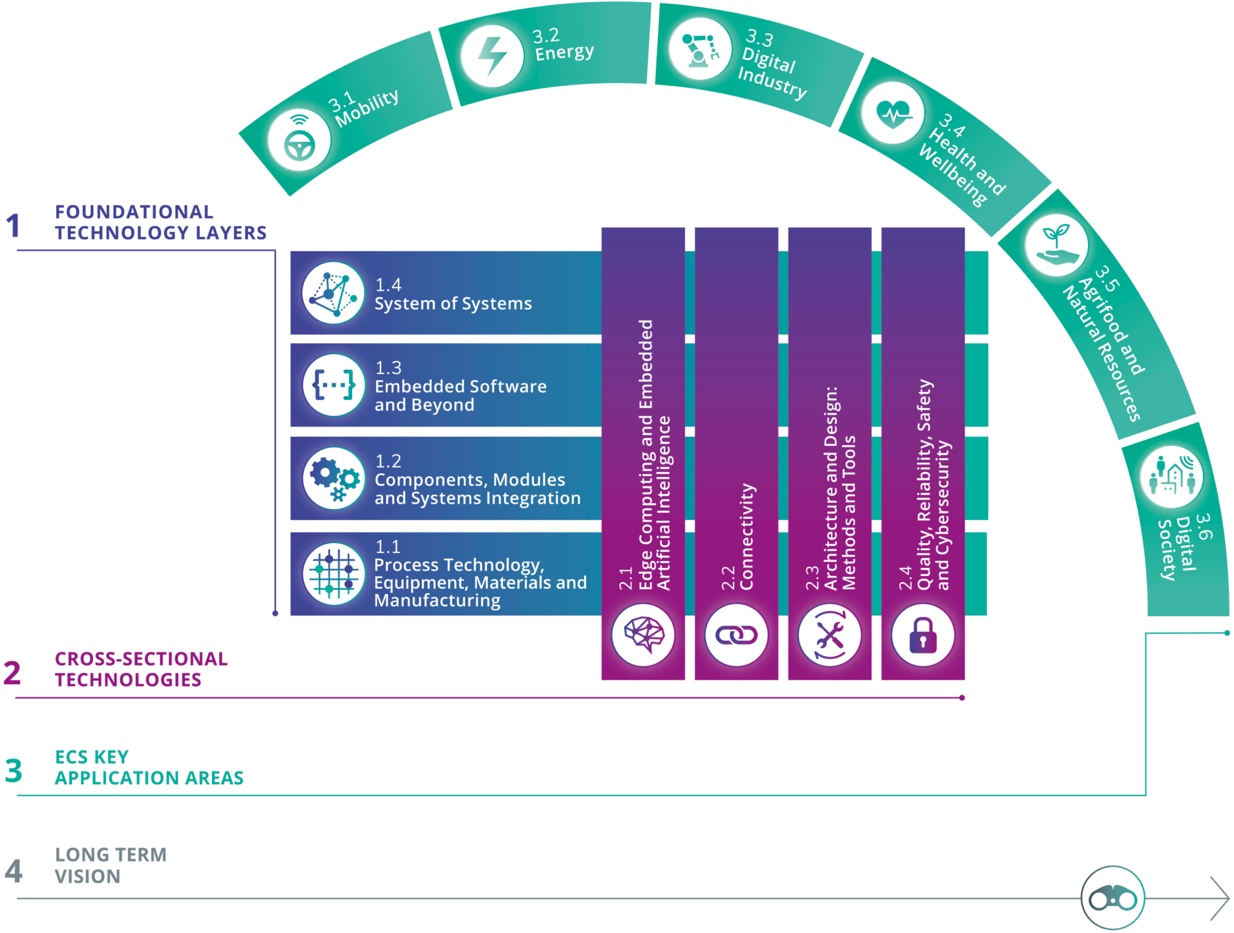
ECS-SRIA detailed summary
In this summary, we start with Section 3 and the application domains, reflecting the stronger policy emphasis on application-driven innovation and societal impact.
Application requirements pull innovation through the Foundational Technology Layers and Cross-Sectional Technologies. Conversely, advances in components, architectures, software and engineering methods create new capabilities and application opportunities. The resulting feedback between application domains, foundational technologies and cross-sectional capabilities is therefore central to the ECS-SRIA: progress in one layer both depends on and generates innovation in others.
The application chapters translate the SRIA’s technology base into concrete system requirements. Mobility is a useful starting point because electrification, software-defined architectures and autonomy are already forcing several ECS layers to change together.
ECS Application Domains
3.1 Mobility
Mobility makes the application-pull logic of the SRIA tangible. Automotive remains Europe’s main volume driver for mobility electronics, while many solutions transfer to rail, maritime and aerospace. The 2027 chapter therefore places power electronics and in particular the Software-Defined Vehicle (SDV) at the centre of the transformation.
As more functionality moves into software, electrical/electronic architectures shift from many distributed control units towards domain- and zonal-based structures and more centralised computing. Different vehicle classes will adopt different combinations, but all require much tighter hardware-software integration.
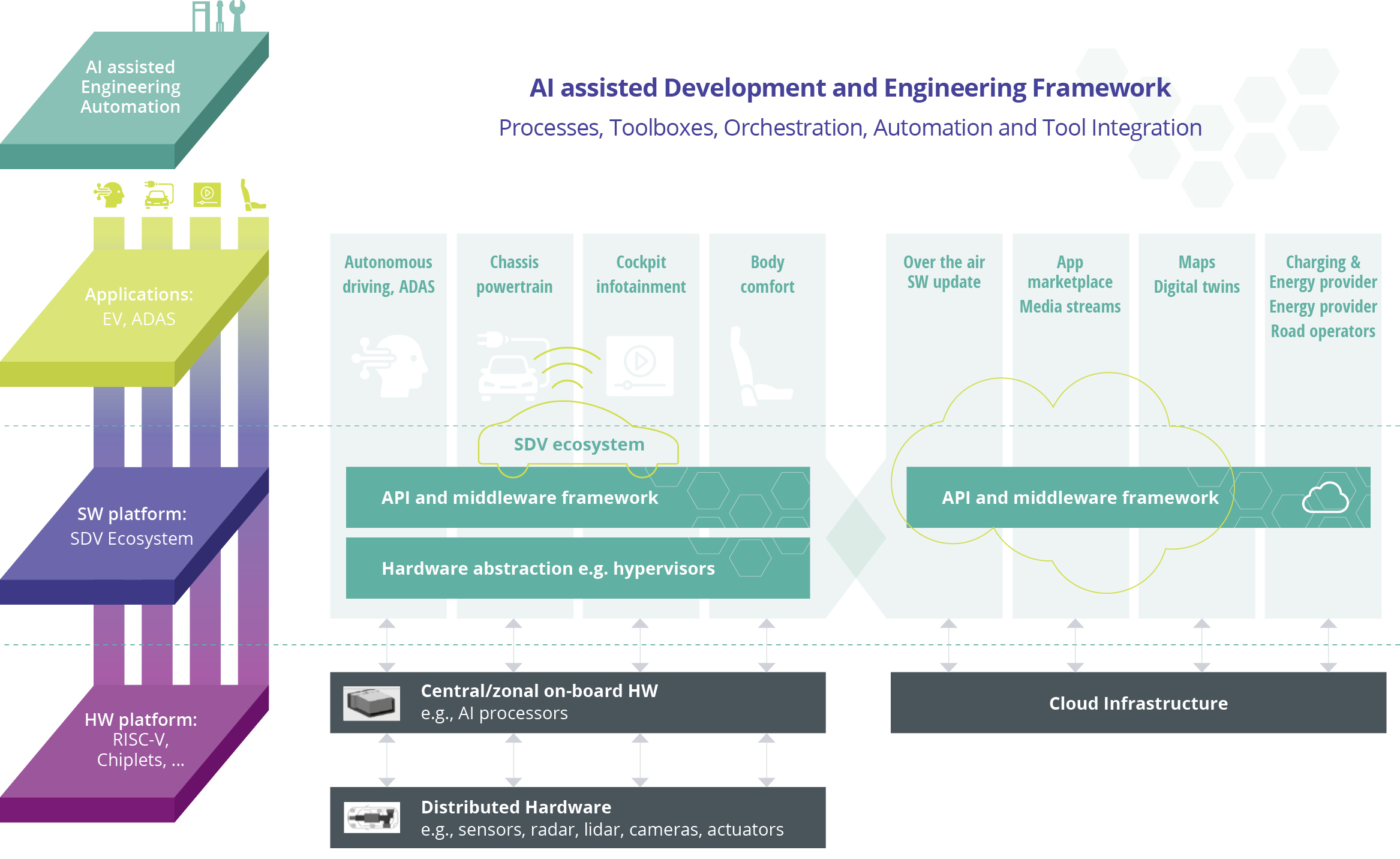
This changes the development model.
Customer-facing and data-driven functions can evolve through short software cycles and over-the-air updates, while safety-critical functions remain tied to rigorous systems engineering and homologation. The resulting two-speed model creates a growing verification burden as software complexity rises. Artificial intelligence is therefore relevant twice: inside the vehicle for perception and decision-making, and in the engineering toolchain for simulation, test generation and validation.
For Europe, the strategic issue is to turn these capabilities into reusable, system-optimised platforms rather than continuing ECU-by-ECU development. This includes European-led computing and software environments that preserve safety, cybersecurity and lifecycle control while supporting faster innovation.
3.2 Energy
Electrification makes resilience a central energy-system requirement. The increasing renewable energy generation is distributed and variable, while transport, heating and industry add new electrical loads with a high-power density and high dynamic behaviour.
The 2027 chapter adds a further pressure point: AI-driven data centres, AI Factories, create concentrated demand and grid-connection challenges, even as artificial intelligence becomes a tool for forecasting and optimizing system operations.
The resulting system is more dynamic at every level. Local mismatches between generation and consumption ask for advanced digital control across all power systems levels – from device and prosumer level to the distribution and transmission networks.
Grid stability, congestion and security must be managed while storage, charging infrastructure and regional energy systems interact more closely. Electronic Components and Systems therefore connect power conversion with sensing, control and communication so that physical energy flows can be coordinated with real-time information.
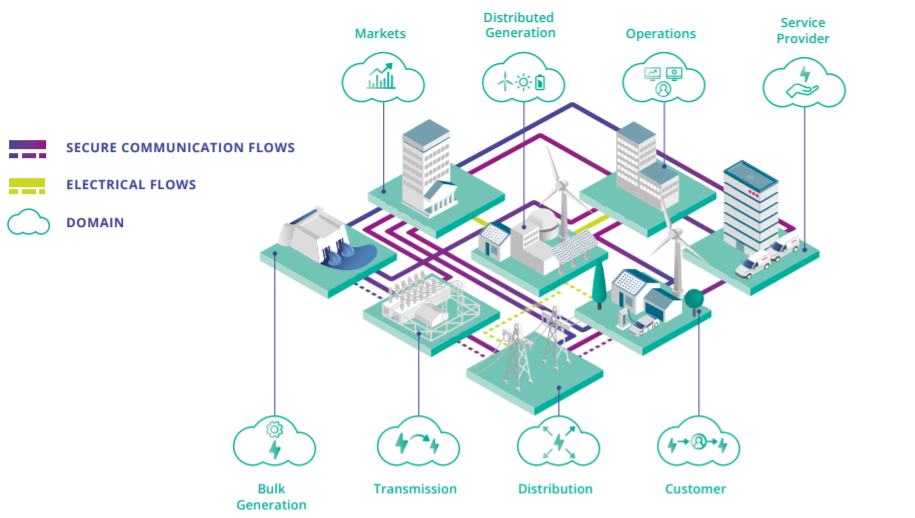
A specific 2027 addition is energy-autonomous sensing with embedded intelligence and Edge-AI.
Such nodes can extend observability to assets where external power or frequent maintenance is difficult, supporting condition monitoring and local decision-making. This is especially relevant for retrofitting existing energy infrastructure rather than relying only on new installations.
The AI-energy relationship runs in both directions: AI increases electricity demand, while better data and control can improve forecasting, maintenance and use of flexibility.
3.3 Digital Industry
Europe’s industrial transition will be decided largely in factories that already exist.
New plants are comparatively rare, while much of Europe’s production base consists of highly automated but heterogeneous equipment built in different technology generations. This challenge cannot only be solved by adding more digital tools. It needs to make brownfield production responsive, interoperable and easier to reconfigure without disrupting operations.
This requires a shift from isolated automation towards distributed intelligence across the industrial edge-to-cloud continuum. Data from machines, processes and enterprise systems must become usable across organisational and technology boundaries. Digital twins and simulation will connect engineering, virtual commissioning, operation and maintenance. Artificial intelligence can then use this context for dynamic planning, quality, resource efficiency and decision-making.
Physical AI takes the next step into autonomous machines and collaborative robots, where perception, reasoning and control must close the loop in real time. Higher autonomy, however, raises the bar for safety, cybersecurity, explainability and human oversight.
The business model changes with the technology. Industrial services already represent a major and growing share of business for many machine and system suppliers.
Condition monitoring, remote operation and lifecycle support turn installed equipment into a continuing service relationship rather than a one-off product sale. Europe can build on its strong machinery, automation and engineering base here. But secure access, data governance and interoperable interfaces are needed to scale knowledge and services across fleets, factories and supply chains.
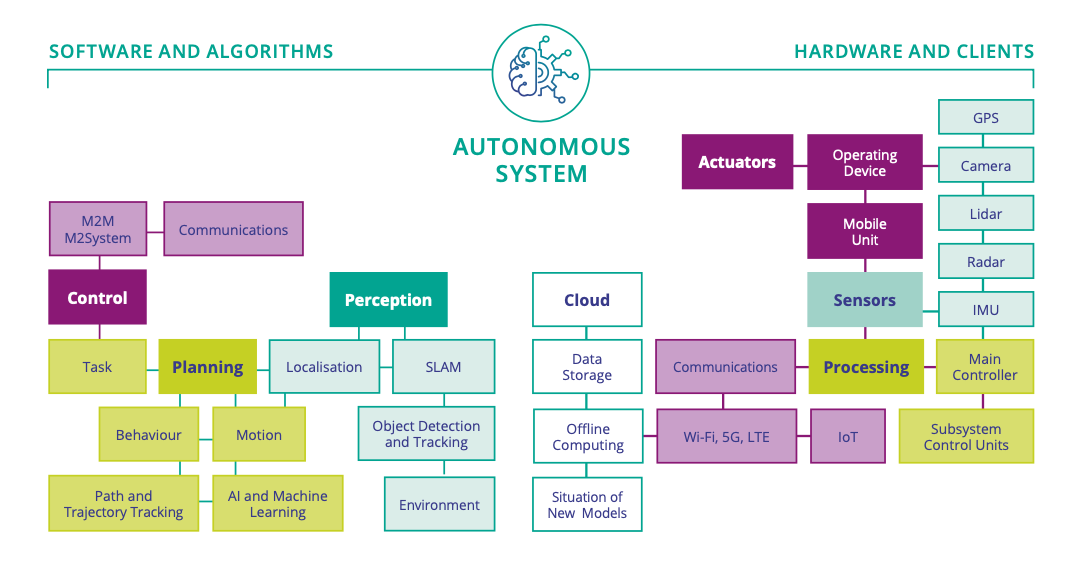
Digital Industry therefore links competitiveness to the ability to modernise existing assets while keeping them productive.
3.4 Health and Wellbeing
Digital health has no shortage of ideas. The harder problem is turning them into solutions that work in real care.
The 2027 chapter stresses that clinical need, care pathways, regulation and reimbursement determine whether an innovation can scale. This matters especially for Electronic Components and Systems (ECS), as many medical devices will remain dedicated to specific clinical uses and therefore have limited production volumes.
The strategic opportunity lies one level below the device, in reusable architectures, platforms and reference designs. Those can support families of separately validated products while aggregating volume across applications. This shifts the ECS contribution from supplying individual digital devices towards enabling the healthcare continuum. It spans prevention and diagnosis, treatment, rehabilitation and care at home. This also clarifies a useful interface for public support.
The Chips Joint Undertaking can strengthen reusable ECS platforms, while health programmes such as the Innovative Health Initiative (IHI) adapt them to care pathways.
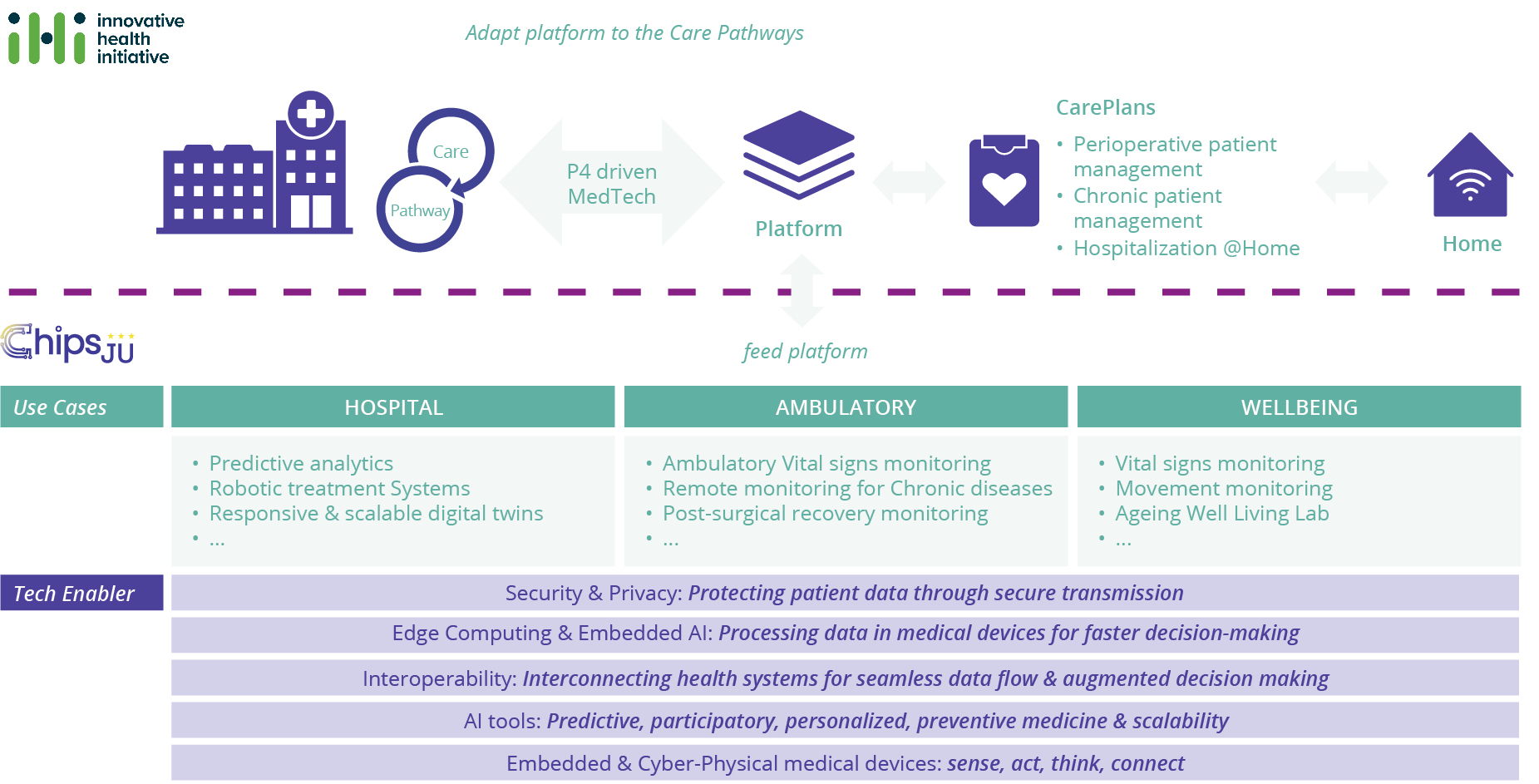
The same architecture must handle increasingly rich and distributed data. The 2027 additions strengthen multimodal approaches that combine imaging, electrophysiology, biochemical and spectroscopic information with data-driven models.
This can make clinical decision support and digital twins more robust and interpretable across molecular, tissue and organ scales. As care moves outside the hospital, low-power local processing becomes more important. For AI-enabled medical devices, interoperability must also be coupled to lifecycle governance. This includes drift monitoring and controlled updates.
The direction is towards predictive, preventive, personalised and participatory healthcare, but the chapter’s message is pragmatic: technology must reduce friction in delivery. It should not add another layer of complexity. As care moves into homes and everyday environments, ECS must operate beyond controlled clinical settings.
3.5 Agrifood and Natural Resources
The agrifood and natural resources sector is undergoing a profound transformation driven by climate change, resource scarcity, biodiversity loss, evolving food-safety risks, digitalisation and increasing demand for resilient, sustainable and trusted food systems.
This Chapter identifies five major challenges: food security and resilient food production; food safety, One Health and trusted food chains; climate-smart, nature-positive and circular production; water resilience, quality and circular management; and biodiversity, ecosystem restoration and nature-positive agrifood systems.
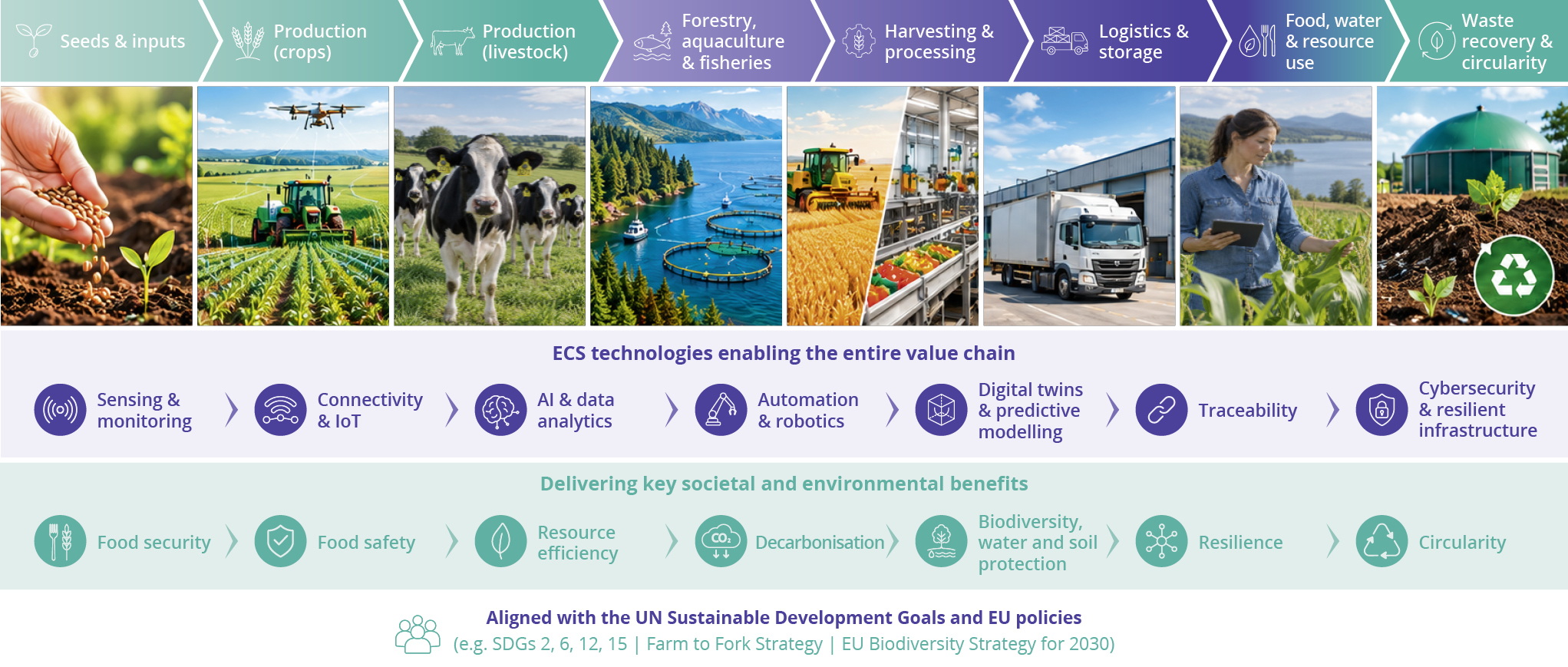
These challenges have to be addressed under demanding operating conditions. Farms, forests, fisheries and water systems are geographically distributed and highly variable. Existing machinery and infrastructure will remain in use for years, while cost, skills and access to power or connectivity can limit deployment. New solutions therefore need to be practical, scalable and suitable for heterogeneous operating environments.
The Chapter emphasises the integration of data across agrifood and natural-resource systems to create adaptive and context-aware solutions. These solutions can improve productivity and food safety while reducing resource consumption, emissions, waste and environmental impacts, and supporting ecosystem restoration.
They can also improve the management of scarce resources and strengthen traceability and trust across food and natural-resource value chains.The proposed research trajectory evolves from monitoring and pilot deployments in 2027–2031, towards integrated predictive systems and coordinated operation in 2032–2036, and ultimately highly autonomous, resilient, circular and nature-positive systems beyond 2037.
The overall ambition is to position ECS as a key enabler of sustainable, resilient and intelligent European agrifood and natural-resource systems.
3.6 Digital Society
As digital services become part of social infrastructure, their value depends on inclusion, resilience and trust.
The Digital Society chapter structures this broad field along two axes: the individual and the collective, and the internal and external sphere. This yields four linked ambitions around personal development, empowerment and resilience, collective safety and inclusion, and supportive infrastructures. The structure connects societal outcomes to concrete Electronic Components and Systems requirements.
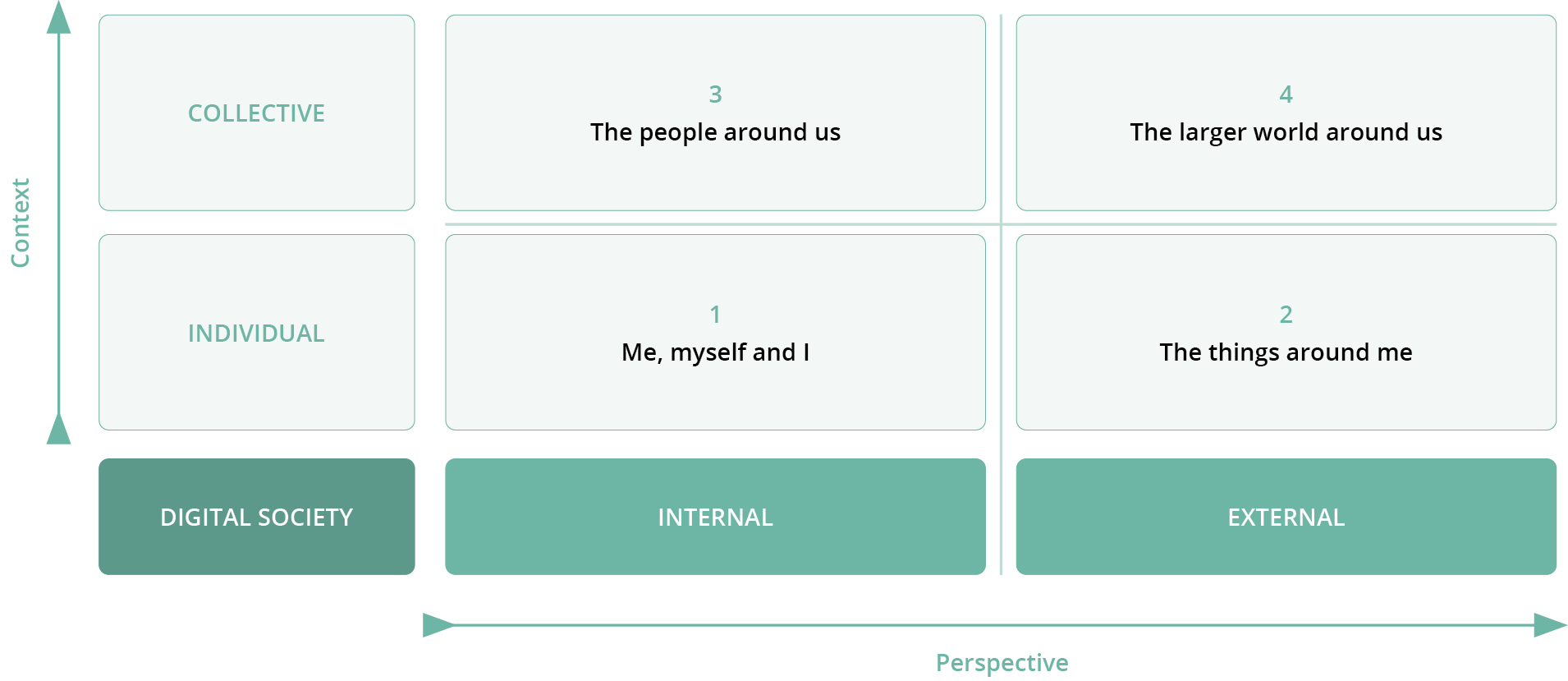
Artificial intelligence developments are having major impacts in this sphere.
Generative and agentic AI increasingly mediate how people create, access and assess information, while broadcasting and media workflows become more distributed and software-defined. The 2027 update therefore gives greater weight to provenance, watermarking, explainability and detection of manipulated or AI-generated content. These are technical requirements for maintaining trust in digital information and services.
Cybersecurity also moves closer to the citizen. Connected devices and online services expose users to identity theft, fraud and AI-enabled impersonation, making authentication and privacy-preserving protection part of everyday digital infrastructure. The chapter extends this perspective to finance, banking and telematics, where ECS supports trusted identities, transactions and data flows.
Reliable connectivity and resilient edge-cloud infrastructures are equally important for remote work, public services, emergency response and connected urban infrastructure.
The chapter’s human-centred perspective is therefore practical. Digital inclusion requires services people can access and trust, while Europe also needs control over the infrastructure and data on which those services depend.
Open and interoperable platforms can reduce lock-in and support sovereign, resilient deployment across public and private infrastructures.
The six application chapters define the demand side of the SRIA. Their requirements converge on ECS that are more capable, efficient, adaptable and trustworthy.
They raise a common engineering question: which physical capabilities must Europe control so that these system-level requirements can become manufacturable products? The answer begins in semiconductor processes, materials and equipment, where performance, energy use, supply resilience and manufacturability are set.
Foundational Technology Layers
1.1 Process Technology, Equipment, Materials and Manufacturing
Semiconductor process technology, equipment and materials form the physical starting point of the ECS stack.
AI is now the main driving force for the semiconductor industry. Rapid growth in AI workloads raises demand for computing performance and exposes limits in data movement, memory access and power delivery. While transistor scaling remains essential, system efficiency depends on how computing, memory, interconnect and integration are designed together.
This broadens the manufacturing challenge beyond leading-edge logic.
The chapter explores technologies for differentiated devices that add sensing, power, photonic and new computing functions. Spintronics links device properties to architectures and embedded intelligence with a stronger materials-to-systems perspective. Advanced integrated photonic and quantum technologies create a similar need for specialised materials, fabrication, metrology and control electronics before they can move from research into scalable products.
AI also impacts packaging. Multi-die AI systems push advanced integration from wafer-level approaches towards panel-level packaging, making assembly accuracy, yield and process control part of the performance equation. This is an area where Europe can build on strong positions in semiconductor equipment, materials and specialised manufacturing technologies.
Manufacturing sustainability is inseparable from this strategy. Fabs consume large amounts of energy and ultra-pure water and depend on fluorinated process chemicals and critical materials. Process optimisation, recycling, abatement and more resource-efficient equipment must advance together with capacity expansion.
Once these semiconductor technologies and manufacturing capabilities exist, the next challenge is integration: turning diverse chips and functions into compact, reliable and manufacturable systems.
1.2 Components, Modules and Systems Integration
Physical and functional integration is where semiconductor capability becomes product capability.
Chapter 1.2 combines devices and functions into components, modules and systems that can meet real constraints on size, power, reliability, cost and lifetime. Advanced packaging provides the common integration platform, while the 2027 update strengthens integrated photonics, micro-electromechanical systems and flexible or structural electronics as important routes to new functionality.
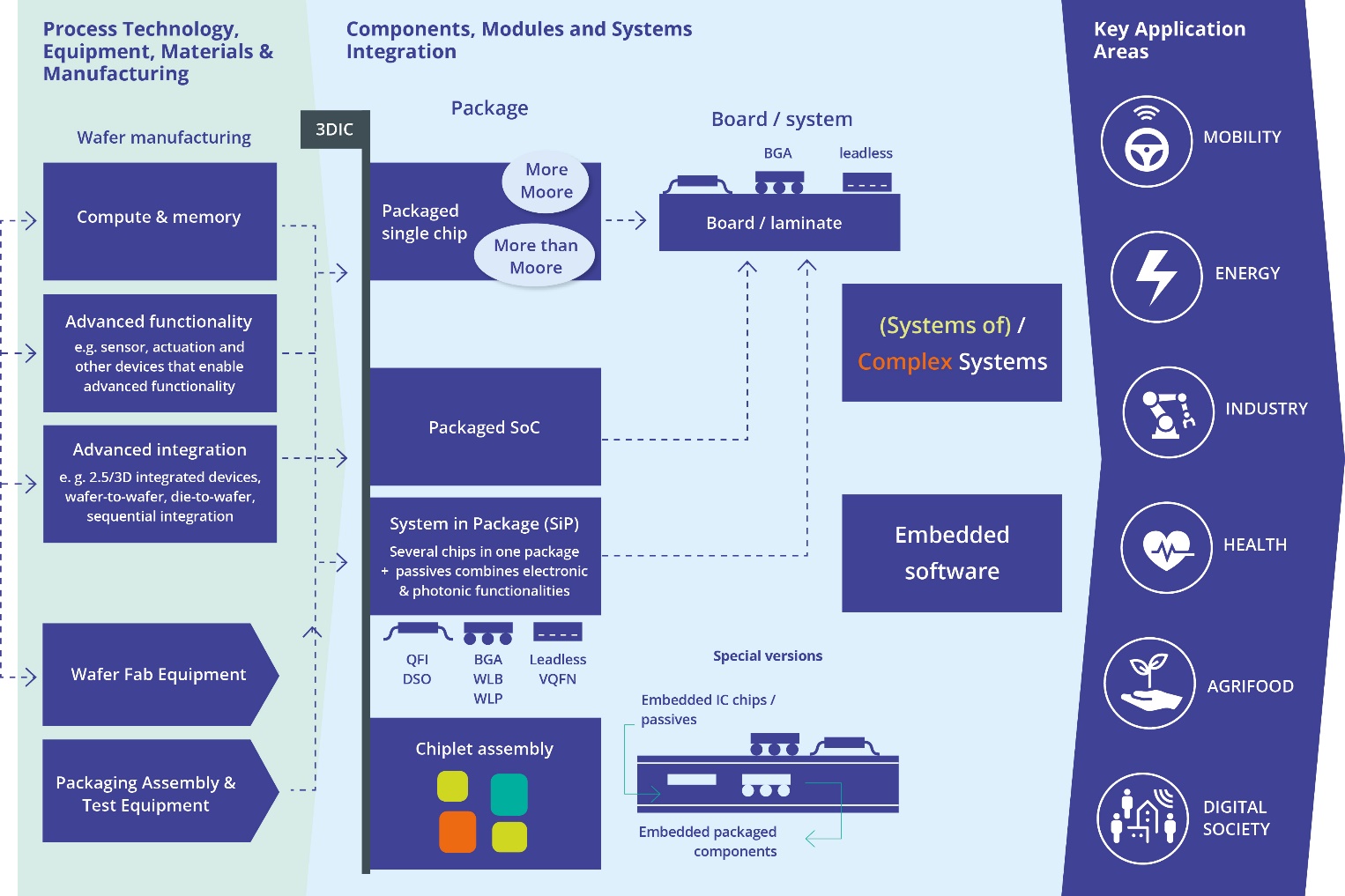
For AI and high-performance computing, integration determines a large part of system efficiency. Compute, memory and interconnect have become a coupled design problem because data movement can dominate both energy use and latency. Co-packaged optics addresses this pressure by bringing optical communication closer to processors where electrical links reach practical limits.
Dense integration also makes thermal management, power delivery, signal integrity and test central architectural choices from the outset.
Distributed sensing shows the same integration problem at the opposite end of the performance spectrum. Compact sensor modules may need to sense, process, communicate and act for years with very limited energy.
The 2027 additions therefore give more weight to realistic energy harvesting, self-powered sensing and robust operation in industrial, environmental and other harsh settings. Micro-electromechanical systems remain a key bridge between the physical world and digital intelligence.
Europe’s strategic task is to carry these integration capabilities from design into scalable production.
Long-lived systems also need repairability, upgradeability, lifecycle reconfiguration and material recovery designed in from the start. This links sovereignty with sustainability and reduces obsolescence risk.
Once the hardware platform is integrated and application-ready, software becomes the main mechanism for adding, updating and adapting functionality.
1.3 Embedded Software and Beyond
Embedded software is an essential source of functionality in many cyber-physical systems.
It connects sensing, computing and actuation and allows products to remain configurable and updateable over long lifetimes. This is particularly important in mobility, industry and healthcare, where hardware may remain in service for many years while functions, threats and user requirements continue to change.
That long lifetime creates a difficult engineering problem.
Software must run across increasingly heterogeneous computing platforms while meeting strict constraints on timing, energy, safety and security. At the same time, new functionality has to coexist with legacy software that may be decades old. Hardware abstraction and reusable software platforms can reduce this complexity and broaden access to specialised computing resources. Their value depends on maintaining predictable behaviour and efficient use of the underlying hardware.
Artificial intelligence now affects embedded software in two directions. AI functions are becoming part of the deployed system, including autonomous software agents. AI is also entering software development, testing and integration. Agentic AI raises the stakes because goal-directed software can adapt during operation and may rely on models, data or external services whose behaviour is harder to anticipate.
Continuous monitoring, verification and clear human accountability therefore become part of the software lifecycle.
Security evidence must evolve with the software as well. A Software Bill of Materials (SBOM) and component provenance help establish what is actually deployed and where vulnerabilities originate. Long-lived systems also need a controlled path towards post-quantum cryptography before deployed products become difficult or costly to migrate.
These lifecycle concerns create a strong interface with the Quality, Reliability, Safety and Cybersecurity chapter.
1.4 System of Systems
A System of Systems (SoS) combines constituent systems that remain operationally and managerially independent. They may have different owners, technologies and lifecycles, yet their cooperation creates functions that no constituent can provide alone. The difficult part is therefore composability: systems have to cooperate even when they were developed separately and continue to evolve at different speeds.
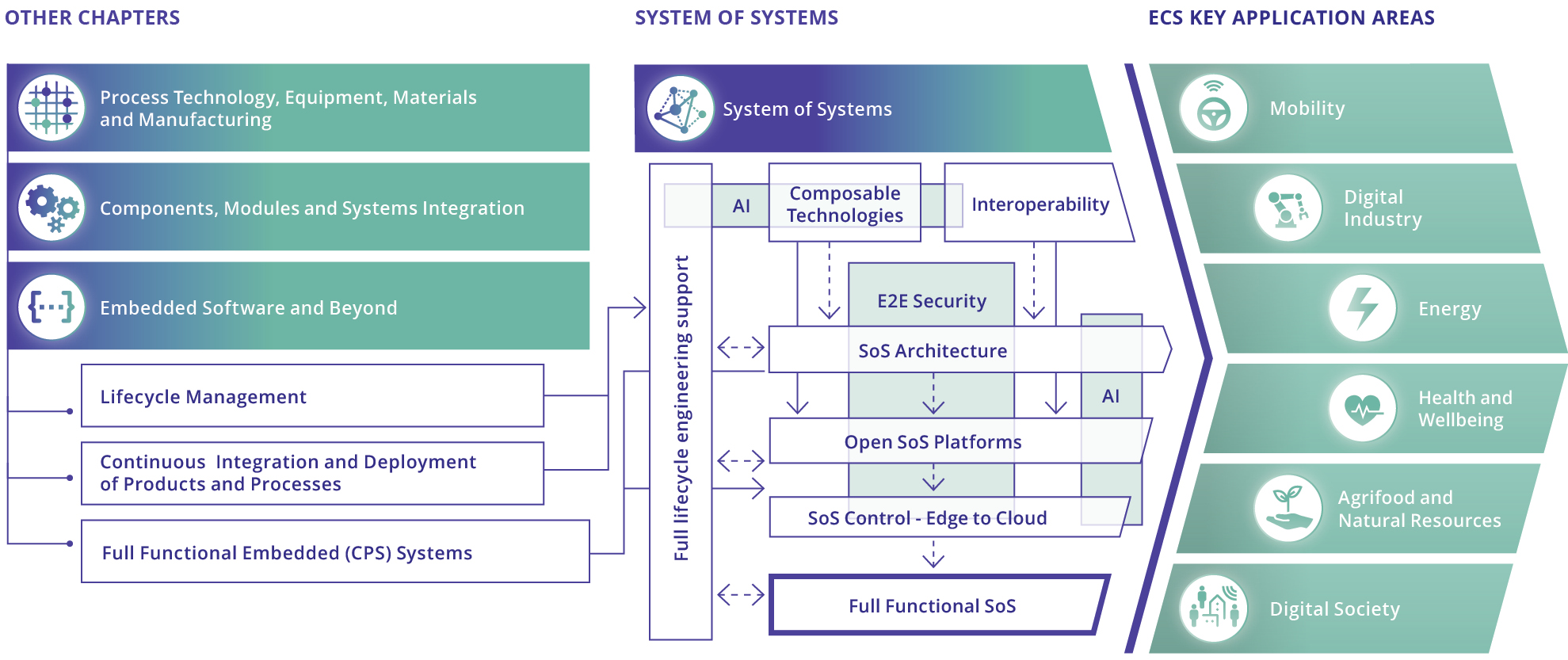
The 2027 chapter extends this principle across a wider part of the Electronic Components and Systems stack. SoS concepts now apply to hardware structures, chiplets and even reusable intellectual-property blocks, as well as to machines and software services. Systems and resources can be added, removed or reorganised during operation.
This makes lifecycle management a runtime concern and raises the importance of maintaining an accurate view of the current composition and state of the overall system.
Open integration infrastructures provide the architectural basis. Service-oriented approaches separate shared infrastructure and integration functions from application-specific solutions, while semantic interoperability helps independently developed systems understand exchanged information.
Across the edge-to-cloud continuum, the same infrastructure has to coordinate computing, deployment and communication resources. Europe already has substantial experience with open SoS platforms; the chapter argues for concentrating this strength into durable European ecosystems with long-term governance and industrial exploitation.
Dynamic composition also changes assurance.
Security, safety, reliability and quality of service depend on the current combination of constituent systems and can change as that combination evolves. Monitoring, validation and adaptation therefore have to continue during operation. The roadmap moves towards autonomous operation and ultimately self-adapting capabilities such as self-healing and self-extension. This also brings SoS directly together with continuous hardware-software engineering in Chapter 2.3.
Cross-Sectional Technologies
The foundational layers define what ECS can be built from; the cross-sectional technologies define how these capabilities can work together across complete systems and lifecycles. They address recurring challenges shared by all application domains: distributed intelligence, connectivity and interoperability, architecture and engineering, and continuous assurance of quality, reliability, safety and cybersecurity. Together, they turn individual technologies into deployable and evolvable system capabilities.
2.1 Edge Computing and Embedded Artificial Intelligence
Where computation and memory sit is becoming as important as raw processing performance.
The edge–cloud continuum therefore treats processing as a placement problem: each task should run where latency, bandwidth, energy, privacy, cost and available resources are best balanced. This becomes more demanding as embedded intelligence moves beyond perception towards generative, agentic and Physical AI, including emerging vision-language-action models.
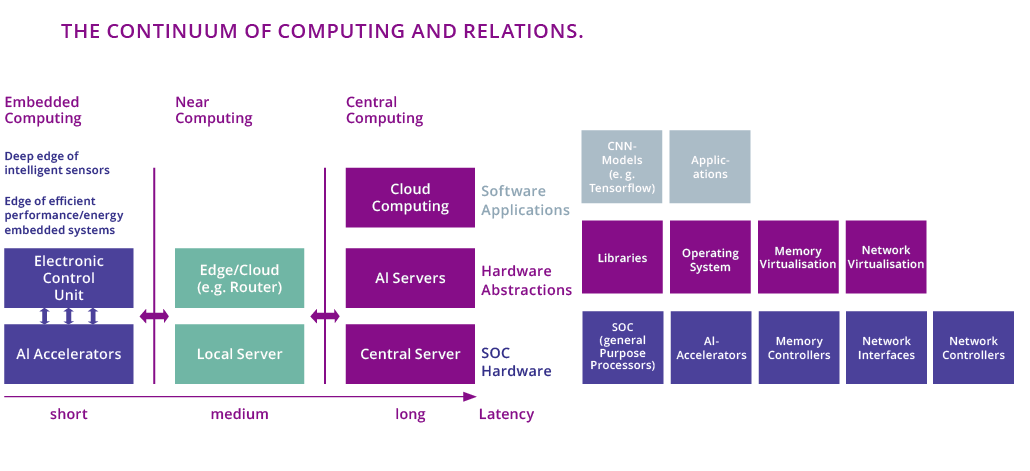
The 2027 chapter gives greater weight to the constraints that appear when these models move closer to sensors and machines. Memory capacity and data movement can dominate the energy and cost of inference, while long contexts and larger models put pressure on Random Access Memory (RAM) well before arithmetic performance is exhausted. Streaming execution, smaller specialised models and dedicated Neural Processing Units can reduce this burden.
The engineering challenge lies in co-designing algorithms, memory and compute so that useful intelligence fits the device and its energy envelope.
This fast-moving field also requires a clear distinction between embedded systems and embedded AI. They share hardware, software and lifecycle constraints, yet AI introduces its own model lifecycle, accelerator, memory and verification requirements.
These requirements evolve much faster than typical embedded platforms. Europe therefore needs programming and deployment environments that remain portable across heterogeneous hardware and support model updates, orchestration and verification over long product lifetimes.
Sustainability is part of the same architectural problem.
Processing locally can reduce data traffic and cloud demand, while modular resource sharing and requalification can extend device lifetime. Open and maintainable European hardware and software ecosystems are important if these gains are to translate into scalable industrial capability.
2.2 Connectivity
A modern Electronic Components and Systems application crosses several connectivity boundaries. Communication may run inside a package, between devices, through local networks, across long distance links, and into edge or cloud services. Chapter 2.2 focuses on one hand on the physical and data link aspects of connectivity (which hardware technologies will help meet the future needs), and on the interoperability challenges which arise as more and more heterogeneous systems are connected, on the other hand.
The 2027 priorities extend both ends of the connectivity continuum. Chiplet interconnects bring very-high-speed communication into the package, while non-terrestrial networks and direct-to-device communication extend cellular systems into space. Security is reinforced towards the physical and lower connectivity stack. These developments make connectivity more dependent on semiconductor technology and packaging choices, and strengthen the links to Chapters 1.1, 1.2 and 2.4. European leadership in differentiated technologies such as analog, RF and photonics are a key asset that needs to be maintained and further developed.
A persistent difficulty appears when systems from different generations and domains have to cooperate. Europe’s factories, vehicles, infrastructures and healthcare systems combine legacy technology with Internet Protocol networks and newer wireless platforms. Useful interoperability has to bridge protocols, security models and data semantics, not just transport packets. The chapter therefore targets translation at design time and runtime, with architectures that can evolve over long system lifecycles.
This leads to connectivity that is more software-defined and virtualised. Network functions can be deployed and reorganised across heterogeneous hardware, while AI can support orchestration and adaptation. European standards, reference architectures and secure implementations become important leverage points because they turn individual connectivity technologies into reusable infrastructure.
2.3 Architecture and Design: Methods and Tools
ECS engineering is moving beyond development processes that largely end when a product enters the market. Future systems will remain connected, software-defined and autonomous, while both hardware and software may evolve during operation.
Engineering therefore has to span the full lifecycle and feed experience from production, operation and maintenance back into design. Digital threads provide the continuity needed between these stages and across supply chains.
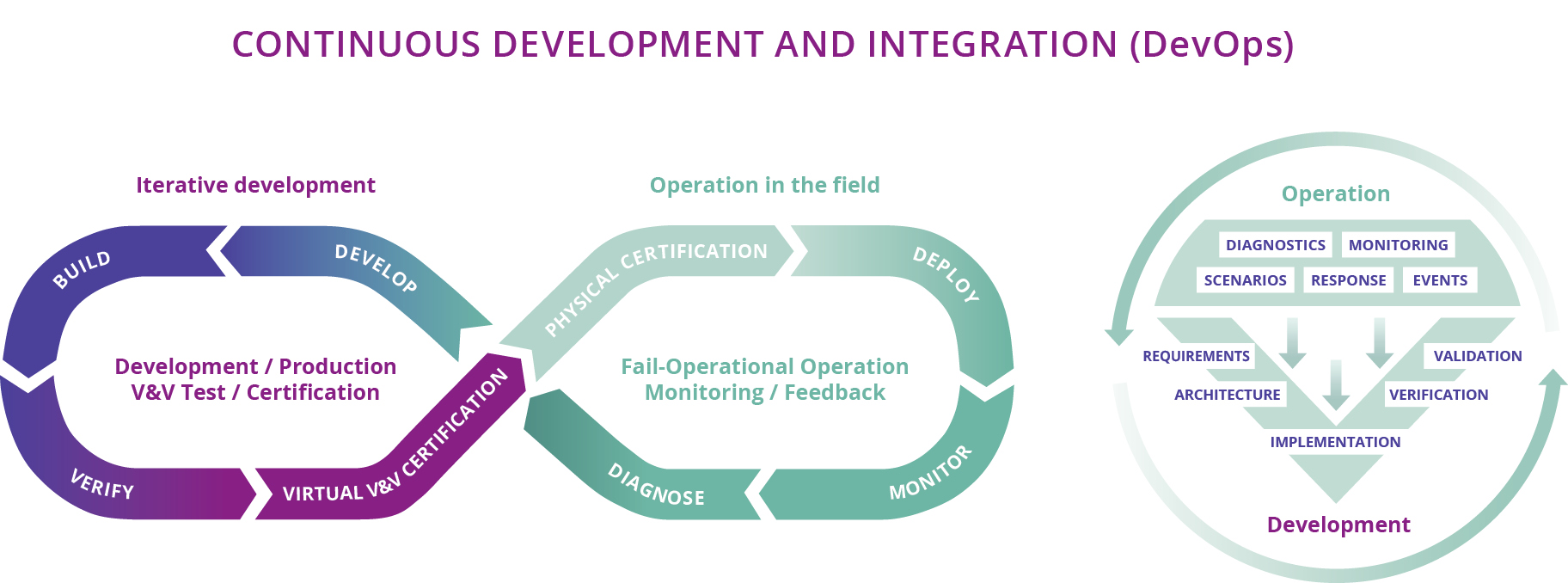
This shift changes verification and validation as much as design. Highly automated systems operate in open environments with an enormous number of possible situations; physical testing alone cannot provide sufficient coverage.
Model-based engineering, digital twins and virtual validation move more analysis earlier in the process and allow field evidence to complement simulation and formal methods. For safety-critical systems, both sources of evidence ultimately have to contribute to credible assurance and certification.
Artificial intelligence is becoming part of this engineering infrastructure. This is the principal 2027 development highlighted by the chapter team.
AI already supports architecture exploration, implementation and testing and is expected to automate progressively larger parts of the engineering workflow. Its value will depend on verification progressing at the same pace. AI-generated designs and code create additional evidence requirements, and the chapter explicitly distinguishes the AI producing an artefact from the mechanisms used to test it.
This is particularly relevant as engineering moves from AI assistance towards more autonomous design and verification.
The underlying engineering problem combines four persistent pressures: development effort, sustainability, system complexity and technological diversity. Interoperable frameworks and reusable models are needed to manage these pressures across increasingly heterogeneous platforms and organisations.
Lifecycle data can then support updates, repair, second-life use and recycling as well as technical optimisation.
Engineering methods determine how a system is created and changed.
2.4 Quality, Reliability, Safety and Cybersecurity
Quality, reliability, safety, cybersecurity, and human acceptance must be considered from the concept and design phases and throughout the entire product lifecycle. Quality is an overarching category that describes the degree to which the set of inherent characteristics of the objects used in and for the fabrication of ECS fulfils the predefined requirements. Reliability is ‘quality over time’ and denotes the probability that ECS perform their intended function for a specified period of time under stated conditions.
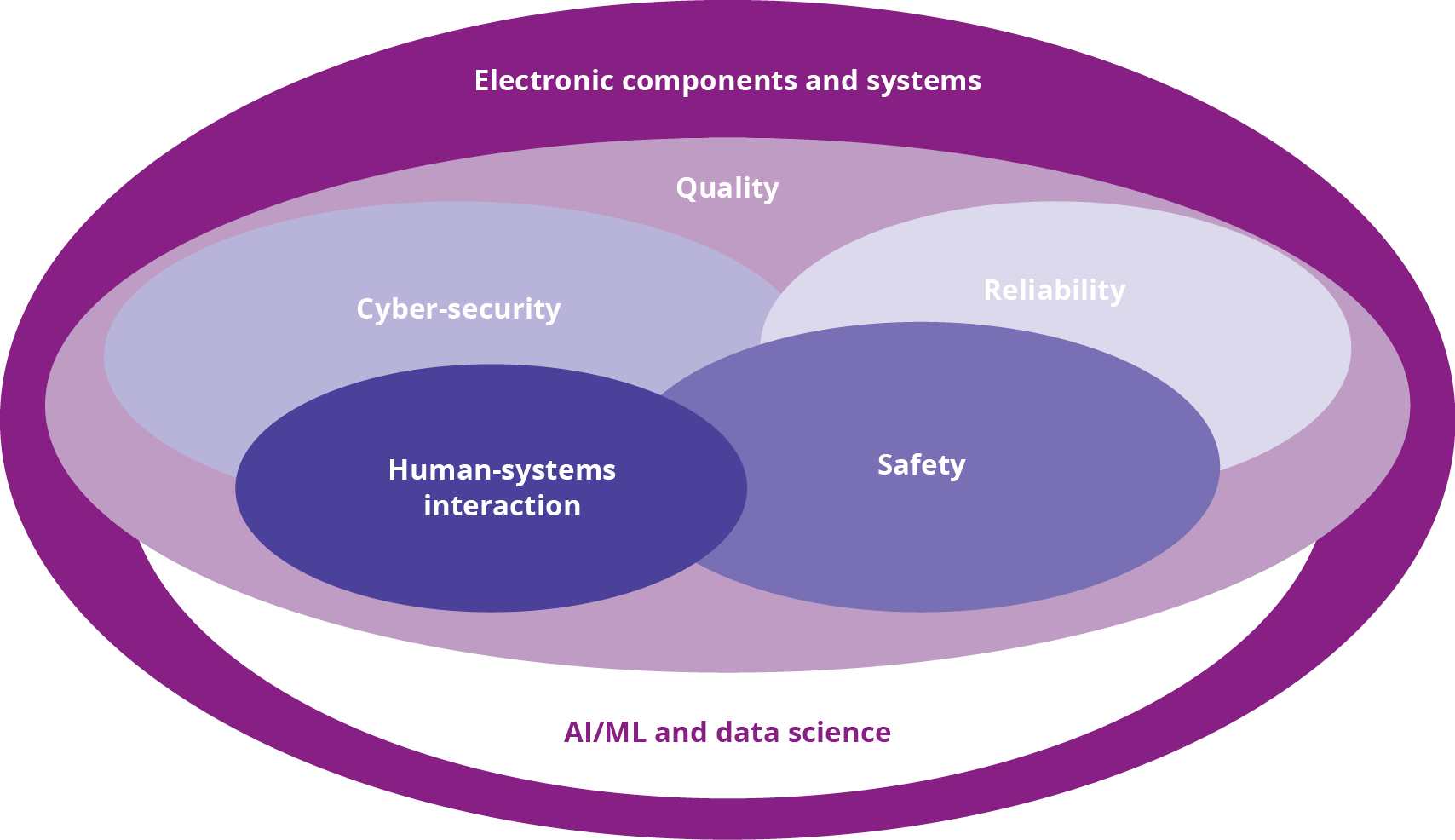
The necessary research focuses on methods and processes to strengthen the fulfilment of all quality requirements, to proactively prevent defects during fabrication, and to slow down degradation during ECS use.For connected and updateable ECS, dependability must also be ensured across the device-edge-cloud continuum. Critical functions need predictable behaviour when communication networks or remote platforms become unavailable or degraded. Runtime monitoring, fault containment, defined degraded modes and fail-over mechanisms are therefore important.
Cybersecurity requires a continuous chain of trust from device hardware to applications. Protection must evolve as threats, software and cryptographic requirements change.
The authenticity and provenance of hardware and software also need to be verified to prevent counterfeit or deliberately modified components from entering critical systems.
AI-based and autonomous functions create additional requirements for safety, traceability and certification. Human requirements, foreseeable misuse, effective oversight and calibrated trust should be considered early enough to influence system design.
The challenge of assuring quality, safety, security, and human acceptance results from the intended increase in functionality of future ECS, which makes them much more complex and leads to stronger user dependence, while global competition puts enormous pressure on time to market.
Chapter 2.4 addresses the priority research actions and provides roadmaps outlining the necessary developments.
Long-Term Vision
Together, the application, foundational and cross-sectional chapters describe the capabilities Europe expects to develop within the present research horizon. They also reveal where that horizon becomes uncertain.
The Long-Term Vision takes up these unresolved gaps and asks which research must start now so that technologies and industrial capabilities are available a decade from today.
The Long-Term Vision brings together three forces that shape future Electronic Components and Systems: technology evolution, application needs and European policy priorities.
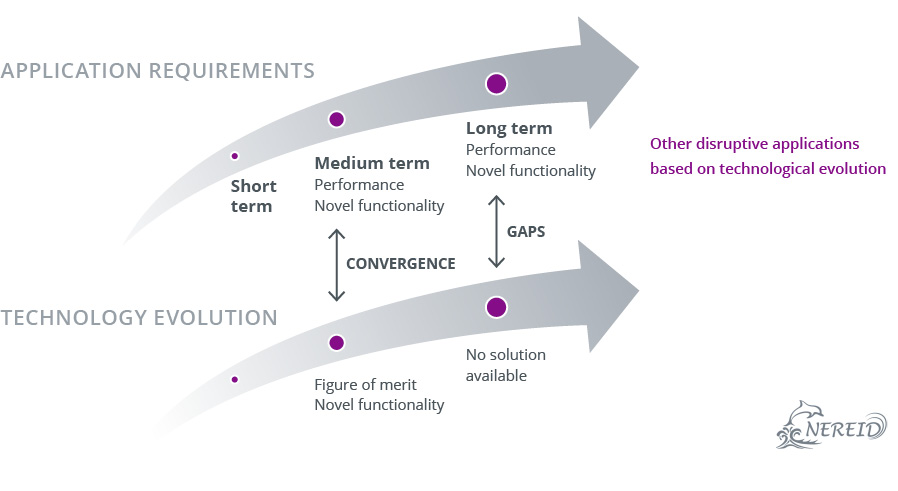
Their interaction is the central idea of the chapter. Application requirements can pull technology towards higher performance or new functionality; new technologies can equally create applications that were not anticipated when a roadmap was written. Where the two trajectories diverge, a research gap emerges. Identifying such gaps early matters because the path from Technology Readiness Level 1 to industrial products can take ten years or more.
Figure 4.1 shows application requirements and technology evolution developing on separate trajectories, with convergence where available technologies satisfy future needs and gaps where they do not. It also leaves space for disruptive technologies to create new application classes. This captures the push-and-pull logic used throughout the SRIA more clearly than another catalogue of future technologies.
One of the most important long-term gaps is computing efficiency. Continued device scaling remains relevant, but energy consumption and data movement start to limit conventional architectures. The chapter therefore looks towards beyond-von-Neumann approaches and tighter integration of processing, memory and communication.
The revised text gives particular weight to neuromorphic computing, where processing and memory are brought closer together and sparse, event-driven operation can substantially reduce energy demand. This requires co-design across devices, architectures, algorithms and software. Integrated photonics addresses related bandwidth and energy constraints, while heterogeneous integration provides the physical route for combining specialised technologies within one system.
Quantum technologies represent a different timescale and maturity profile. Quantum sensing and secure communications are already approaching specialised applications, while large-scale fault-tolerant quantum computing remains a longer-term research challenge. Classical electronics, fabrication, cryogenic interfaces, control and software are therefore part of the quantum agenda as much as the qubits themselves.
The long-term objective is a complementary computing capability for selected problems where conventional approaches become inefficient.
Artificial intelligence has a similarly broad influence across the ECS stack. It is becoming an engineering technology for design-space exploration, implementation, verification and test, while embedded and cyber-physical systems are stronger intertwined with AI during operation. The limiting factors extend beyond compute performance.
Suitable training data, predictable behaviour in changing environments and credible verification remain fundamental research issues. Trustworthiness, explainability and certification therefore have to evolve together with the underlying AI capabilities.
At system level, the long-term trend points towards distributed, interconnected and adaptive systems.
Hardware, software and services will evolve over different lifetimes, while systems of systems will increasingly coordinate resources and behaviour across the edge–cloud continuum. This raises long-term questions around composability, semantic interoperability, emergent behaviour and continuous assurance. Human interaction becomes part of the same system problem as autonomy increases, particularly in health, mobility, industrial automation and digital society.
Sustainability and strategic autonomy set the boundary conditions for these developments. Future ECS must reduce their own consumption of energy, water, materials and environmentally critical substances while enabling more efficient systems in energy, mobility, industry and resource management. Europe also needs enduring competence in the technologies, manufacturing capabilities and engineering knowledge that determine control over critical value chains.
The chapter therefore treats Europe’s network of universities, research and technology organisations and industry as a strategic asset: long-term leadership depends on continuity between basic research, applied research and industrial capability.
Whatever the application domains, future systems become more distributed, autonomous and closely integrated with the physical world, while expectations for energy efficiency, resilience and trust continue to rise. The purpose of the Long-Term Vision is therefore to keep research ahead of these requirements and to preserve room for disruptive technologies that current application roadmaps cannot yet foresee.
Conclusion
The SRIA therefore closes by looking beyond today’s roadmaps: which capabilities must Europe start building now to remain competitive and technologically sovereign over the coming decade?
The application chapters define emerging needs; the foundational and cross-sectional chapters show how those needs can be translated into technological capability.
The Long-Term Vision identifies where today’s trajectories still leave gaps and where new technologies may open entirely new directions.
Maintaining European strength requires continuity from scientific research to industrial capability, and from components to complete systems.
It also requires enough openness to capture innovations that present roadmaps cannot yet predict.
By making these dependencies visible early, the SRIA provides a common basis for coordinated European research and innovation priorities.