
ECS SRIA 2027
0. Introduction and Overview
On this page
- 0.1 PART 1 – WHY? GOALS AND PURPOSES OF ECS SRIA 2027
- 0.1.1 The ECS SRIA: An agenda aligned with European priorities
- 0.1.2 The ECS ecosystem: a key enabler of prosperity for Europe
- 0.2 PART 2 – WHAT? CONTENTS OF ECS SRIA 2027
- 0.2.1 Scope
- 0.2.2 The structure
- 0.2.3 The ECS SRIA and its position in the technology landscape
- 0.2.4 New and growing trends
- 0.2.5 Further changes vs. previous edition
- 0.2.6 The ECS global timeline for Europe
- 0.2.7 The ECS SRIA outline
- 0.3 PART 3 - HOW? Navigating the ECS SRIA
0.1 PART 1 – WHY? GOALS AND PURPOSES OF ECS SRIA 2027
Trade and geopolitical tensions, climate change, ageing societies and rapid advances in artificial intelligence are changing both the demand for Electronic Components and Systems (ECS) and the conditions under which they are developed. In particular, ECS bear the promise to be key enabling tools allowing to overcome many of the challenges Europe is facing. Europe's competitiveness and resilience depend on its ability to turn research excellence into dependable ECS at industrial scale. With many technology options and limited financial and human resources, Europe needs to focus collaborative research where it can build strength, address critical dependencies and create value in strategic applications.
This is the purpose of this ECS Strategic Research and Innovation Agenda (ECS SRIA), jointly developed by the experts of the European ECS community, coordinated by the three industry associations: AENEAS, INSIDE Industry Association (formerly ARTEMIS-IA) and EPoSS. This tenth edition identifies the Major Challenges, necessary RD&I efforts and expected outcomes. The technology domains addressed range from micro- and nanoelectronics, smart electronics system integration (e.g. chiplets) via embedded and cyber physical systems to complex system of systems integration. It is an essential tool to drive the ECS research and innovation efforts in Europe with the ultimate goal of creating value, growth, jobs and prosperity.
0.1.1 The ECS SRIA: An agenda aligned with European priorities
ECS are the key technology, enabler and differentiating factor behind all mass applications and their innovations, serving a market of over 61 trillion Euro (see figure 0.1). Therefore, a very broad scope in the applications, in the design, the underlaying technologies, the requirements and in the manufacturing is addressed in this document, resulting in the identification of 72 Major Challenges.
They are frequently interdependent – they influence each other, become increasingly demanding, and have an impact on many areas, including technology innovation, industrial competitiveness, security, safety, business and environmental sustainability, society, etc. From this perspective, and as shown in the major challenges table in Appendix B, the Major Challenges represent key factors for the achievement of five Main Common Objectives, which are aligned with the European Commission’s strategic priorities:
Boost industrial competitiveness
Ensure EU digital autonomy
Establish and strengthen sustainable and resilient value chains
Unleash the full potential of intelligent and autonomous ECS-based systems
Enable the ECS Engineering Ecosystem
The SRIA is developed collaboratively by numerous technical experts from industry and academia, each contributing perspective shaped by their respective background and industrial areas of interest. Its purpose is not to prioritize specific areas of the electronics components and systems domains or individual research and innovation activities. Rather, it reflects a holistic view and collective vision for advancing electronics-based industries in Europe as a whole and along complete value chains.
The three authoring industry associations — AENEAS, EPoSS and INSIDE — , which together represent the whole European ECS R&I community, are committed to identifying and discussing intersections between political priorities and the broad spectrum of activities pursued by their members.
0.2.1.1 Objective 1: Boost industrial competitiveness through interdisciplinary technology innovations
Investing in the Research and Innovation topics described in this document will not only translate into a more competitive and sovereign European ECS value chain, but it will also boost European industrial competitiveness across all sectors.
Electronic components and systems, by their inherent nature, are the result of interdisciplinary research and engineering. These require competencies in diverse technology domains, including process technology, equipment, materials and manufacturing, electronics, and embedded software, as well as cross-sectional technologies such as edge computing, artificial intelligence, high-speed connectivity, and cybersecurity.
As a result, ECS research needs to be interdisciplinary to benefit from the multiple available sources of innovation, as well as research-intensive and market-oriented. This will ensure forthcoming ECS innovations will be of strategic value for Europe and boost its industrial competitiveness in all its value chains, and help building the strong industrial base essential for European strategic autonomy.
The European Chips Act has moved into implementation. Under the Chips for Europe Initiative, the Chips Joint Undertaking combines research and innovation with technology and engineering capacity building. Current implementation includes:
A European Design Platform providing access to design facilities, intellectual property libraries, Electronic Design Automation (EDA) tools and support services;
Five pilot lines for process development, test and experimentation, and small-scale production, linking research to near-industrial capabilities;
Capacity building for quantum chips and associated semiconductor technologies;
A European network of semiconductor competence centres. All Member States and Norway have established centres that provide access to expertise, training and Chips Act infrastructure.
These instruments connect collaborative research with process development, design, test and near-industrial experimentation. The ECS SRIA identifies the research, development and innovation bottlenecks that should feed this capacity and helps align upstream research with prototyping and industrial uptake. This role complements first-of-a-kind manufacturing investments under the Chips Act.
0.2.1.2 Objective 2: Ensure EU digital autonomy through secure, safe and reliable ECS supporting key European application domains
The benefits for European strategic autonomy of the development of innovative ECS technologies focused on security, safety, reliability, dependability and privacy will be discussed in the section “strategic advantages for the EU”. European technology-based, secure, safe and reliable ECS, combined with European AI solutions, are critical to securing global leadership and strategic autonomy in key areas such as Information and communications technology (ICT) and to ensure compatibility with EU values.
These innovative technologies will simplify the implementation of the European Strategy for Data1,2, and ensure security, privacy-by-design and strategic autonomy all along the industrial and digital value chains.
Europe's strategic autonomy depends on capabilities across the ECS value chain and on reliable access to technologies that are critical for downstream industries. The Major Challenges therefore address secure, safe and reliable ECS for key application domains including:
Aerospace, defence, security.
Automotive, transportation.
Machinery, robotics, electrical equipment, energy.
Communications, computing.
Energy generation, distribution and grids
Healthcare and well-being
and other domains.
Defence, security and space now provide a stronger application pull for trusted and high-reliability electronics, advanced sensing and radio-frequency technologies, secure connectivity, resilient computing, autonomous functions and efficient power electronics. These needs cut across the existing technology and application chapters and are treated as cross-cutting drivers within the current SRIA structure.
European strategic autonomy in ECS depends on reducing critical dependencies while retaining access to global markets and technologies. Resilience therefore requires diversified and trusted supply chains, strong European capabilities and the ability to maintain essential functions during geopolitical, trade or supply disruptions. This requires:
Strengthening European capabilities in semiconductor design, manufacturing, equipment, materials, embedded software and system integration where they are strategically relevant, meeting stringent security requirements.
Diversifying sources and manufacturing options for critical components, materials and technologies, and improving visibility across the supply chain.
Ensuring that critical digital and physical infrastructure can rely on secure, trusted and maintainable ECS throughout the product lifecycle.
Using European strengths in specialised semiconductors, systems engineering and application integration to create competitive products and reduce single points of dependency.
0.2.1.3 Objective 3: Establish and strengthen sustainable and resilient ECS value chains supporting the Green Deal
European strategic autonomy will also require the sustainability and resilience of the entire ECS value chain since the development of innovative technologies focused on sustainability and the Green Deal will support ambitions to achieve a green, resilient and competitive Europe.
Moreover, the serious effects of climate change that we are experiencing daily and the current geo-political situation, which highlights our dependency on non-European fossil energy providers, further reinforce the need for Europe to accelerate its transition to climate neutrality by 2050.
This challenge must be perceived as an opportunity to create a new environment for boosting innovative aspects of technology and business models through achieving the following:
Relying extensively on ECS-based technologies and digitalisation as key factors for lowering our global energy footprint at all levels of the economy, and by placing sustainability at the heart of combined digital and green transitions.
Positioning the European players in hardware as front-runners in sustainability to secure a wider market so they can become world leaders. This will need European companies to consider the circular economy, new market positioning (by turning small market shares into specialisation areas), the environmental impact of global manufacturing, etc.
Establishing this carbon-neutrality challenge, based on a close link between the digital and green transitions at the core of future funded collaborative research and innovation in ECS. This will help ensure a positive impact for each stage of the value chain, and achieve carbon neutrality right down to the final application/digital service.
Even in a changing geopolitical context, climate change remains an environmental and economic imperative that cannot be ignored.
Advances in ECS technologies are both a major enabler of the Green Deal for all ECS-based application fields, and a direct contributor through their significant impact on power and resource consumption of ECS manufacturing and use.
Furthermore, the strategic autonomy introduced by the Chips Act contributes to economic sustainability and security, through a reduced dependency on non-European suppliers, an increased production capacity, more competitive manufacturing processes and products, a resilient supply chain, circular economy promotion, etc.
0.2.1.4 Objective 4: Unleash the full potential of intelligent and autonomous ECS-based systems for the European digital era
ECS must have intelligence and autonomy capabilities to control their complexity more efficiently and more cost-effectively. This will help provide novel advanced functionalities and services, limit human presence to only where it is strictly required, improve the efficiency of vertical applications, etc. Intelligence and autonomy are also required for the role of ECS in the application domains, representing an important factor for the sustainability and resilience of the value chains: an ECS-based system that provides intelligent energy management, relying on technologies such as AI, represents a key building block – for example, for smart home and energy applications. Moreover, it also improves the resilience required to ensure optimal energy consumption in critical conditions and contributes to the sustainability of the value chain associated with vertical applications, since it reduces operational costs and environmental impact, improves the quality of service (QoS), return on investment (ROI), etc., thereby strengthening the global competitiveness of European companies and helping to achieve the objectives of the EU’s Green Deal. Physical AI extends this challenge to systems that perceive, reason and act in the physical world, where real-time behaviour, functional safety and verification become part of the AI-enabled function.
Europe's position in artificial intelligence also depends on the hardware and systems that make AI efficient, dependable and deployable. Research in semiconductors, memory, advanced integration, embedded and edge AI, and trustworthy engineering supports applications across the SRIA. Chapter 2.1 addresses the edge and embedded part of this continuum, while other chapters cover the enabling hardware, connectivity, software and engineering methods.
0.2.1.5 Objective 5: Enable the ECS Engineering Ecosystem
Modern ECS-based systems are too complex to deliver reliably without a coherent end-to-end engineering ecosystem that spans requirements, architecture, design, verification and validation, deployment/commissioning, operations and remote maintenance, and eventually recycling and evolution. Establishing such an ecosystem—grounded in systems-engineering best practice—improves quality, reduces time-to-market, and enables confident scaling from components to complex systems and systems-of-systems.
This objective promotes lifecycle integration through model-based and data-centric methods, including Model-Based Systems Engineering (MBSE) and an unbroken digital thread. Product information, analyses and decisions should remain consistent from concept to field operation. Interoperable toolchains and open interfaces support co-design across the computing continuum and modular hardware such as chiplets. Design platforms can provide shared access to intellectual property (IP), process design kits (PDKs) and design automation in secure environments. The Data Act adds concrete requirements for access to data from connected products and for interoperability. This reinforces the value of lifecycle data and digital threads in engineering practice.
In this sense, security, safety, reliability and sustainability are treated by design. Engineering processes should cover cybersecurity and functional-safety lifecycles from architecture through operation and maintenance. The Artificial Intelligence Act, Cyber Resilience Act and revised Product Liability Directive reinforce the need for traceability, secure update mechanisms and lifecycle assurance. Lifecycle-integrated verification and continuous assurance are central to dependable ECS.
Delivering this objective also depends on human capital: Europe needs coordinated education, up-/re-skilling, and hands-on training pathways that match real engineering workflows across the semiconductor and ECS supply chains. (Multiple recent European analyses highlight the skills gap and the need for joined-up action by industry, academia and governments.)
In practice, Objective 5 will:
impact industrial competitiveness by simplifying life cycle management, and improves the quality of the engineering process, making it more cost-effective and agile.
simplify and improve the development of trustworthy ECS technologies, products and applications.
support sustainability and resilience that reduce lifecycle management costs, as well as ensuring the automation and continuity of operations.
unleash the full potential of intelligent and autonomous ECS, which requires completely new approaches to engineering, design and development methodologies, as well as toolchains and tools.
improve professional training and education by strengthening and developing new and specific skills.
By consolidating these capabilities, Europe will simplify lifecycle management, raise engineering quality and agility, and reduce cost and risk—thereby amplifying the impact of Objectives 1–4.
0.1.2 The ECS ecosystem: a key enabler of prosperity for Europe
The importance for Europe of the ECS ecosystem is twofold. It is a major contributor to European economic and political strength through employment, wealth creation and technological capabilities. At the same time, ECS enable services and infrastructures across most areas of daily life and industrial activity.
A ECS as a Strategic Enabler for Europe
Semiconductors are a large and rapidly growing global market, with worldwide sales of around USD 0.8 trillion in 2025. The ECS sector supports a substantial European skills and employment base. Around 1.3 million people work in the EU manufacture of computer, electronic and optical products, while the semiconductor sector itself accounts for roughly 380,000 professionals. Europe currently accounts for around 9–10% of the global semiconductor market, while the Digital Decade target remains 20% by 2030. Recent growth is strongly shaped by artificial intelligence infrastructure, advanced computing and memory, while electrification and connected products sustain demand across industrial sectors. For Europe, the relevant competitive position extends beyond chip manufacturing to equipment, materials, specialised semiconductors, embedded software and system integration.
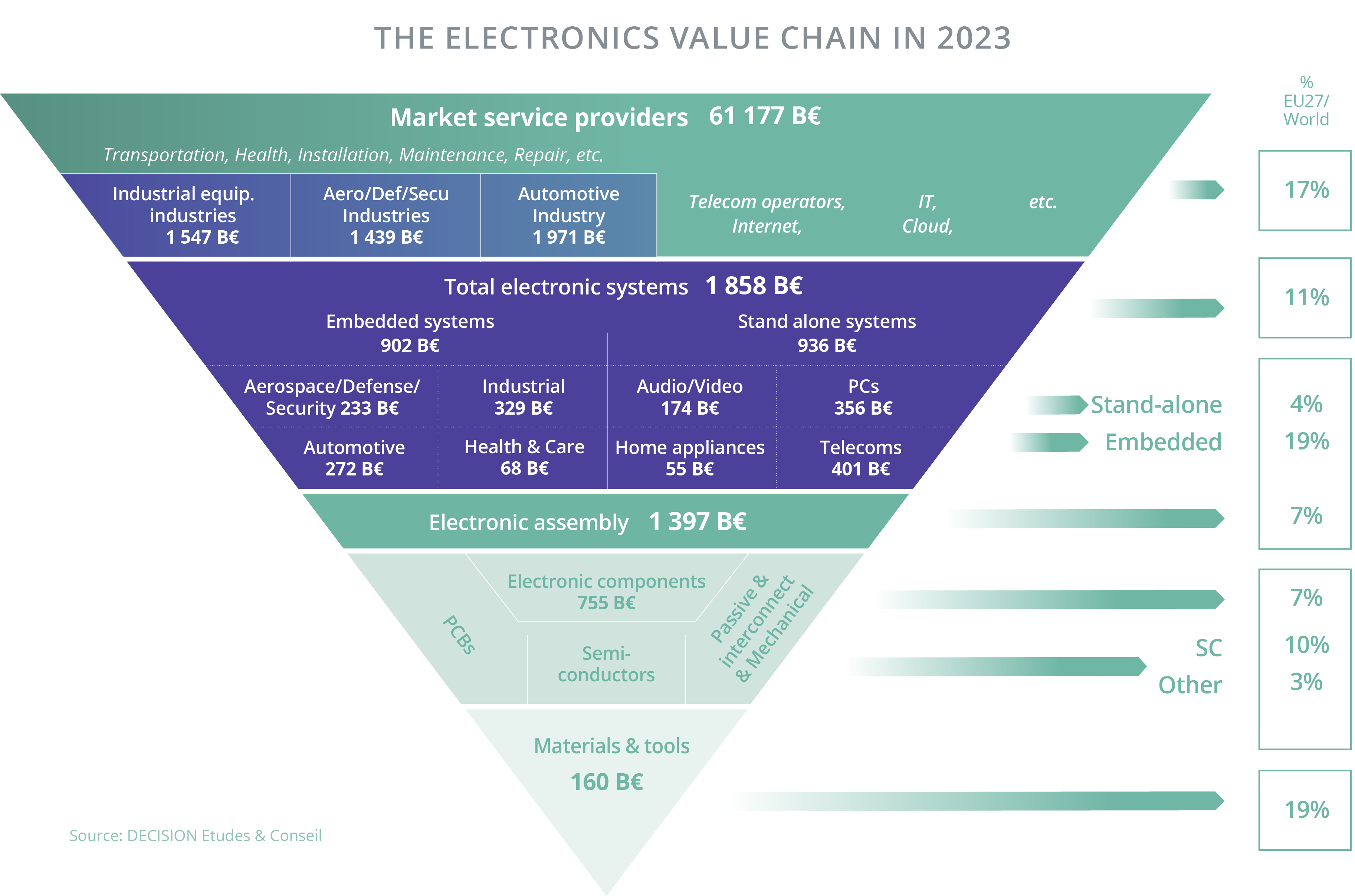
Figure 0.1 Process technology, equipment, materials and manufacturing is at the base of the digital value chain (Source: DECISION Etudes & Conseil) – 2023 market size numbers
These shifts also change the technical bottlenecks. Compute and memory bandwidth, advanced integration, power delivery and trusted embedded systems now matter alongside manufacturing capacity.
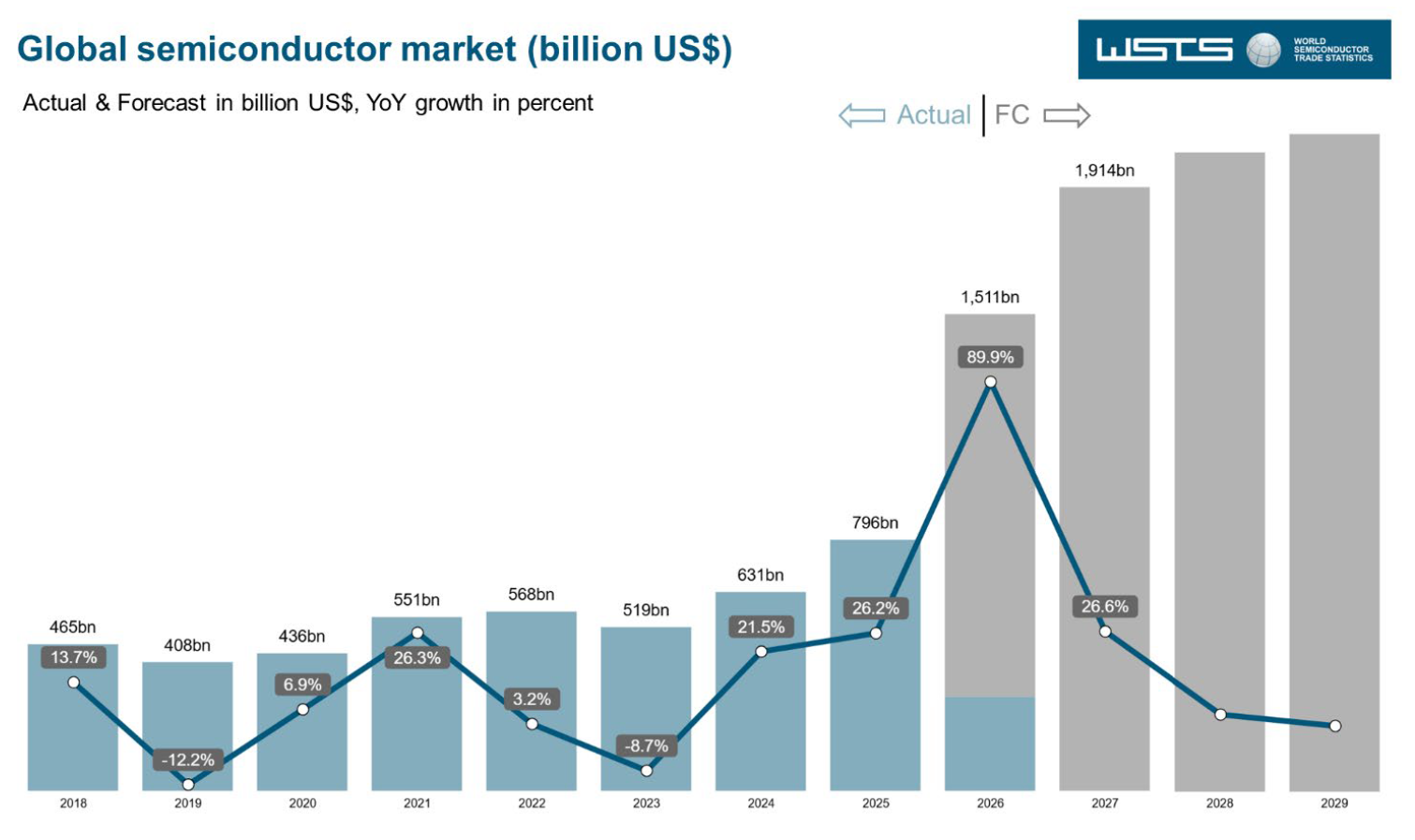
Figure 0.2 Semiconductor market evolution 2018 – 2029 (Source: WSTS)
Europe therefore needs competitive capabilities across complete ECS value chains and the sectors that depend on them. These capabilities support industrial productivity, secure digital infrastructure and resilience to supply disruptions.
0.2.1.5.1 Maintaining competitiveness of the European ECS value chain
Even though the European microchips manufacturing market share is only around 10 %, the European share of integrated products and electronic systems is much higher, for example in the automotive and telecom sectors. Many European companies master specialties technologies, including integration of those technologies into smart systems, combining hardware and software - including firmware and middleware -, which allow them to grab a relatively high share of the end-product value.
Systems-of-systems3 (SoS) and their formalisation were originally conceived and studied in the defence domain, but they are (and will be) vital infrastructure for many other vertical domains. For example, the shift in the mobility sector towards electrification and autonomous mobility necessitates the adoption of systems-of-systems in e.g. vehicles and roadside infrastructure. Given current and future expectations of the market, investment in SoS research and innovation4 is essential to European leadership in the mobility sector. Likewise, to remain at the state-of-the-art in embedded systems architecture and software Europe should continue to invest in this domain, despite fierce competition. From this perspective, the convergence between AI and edge computing - embedded intelligence - should be a top priority.
Europe is internationally known for high-quality products and strong systems engineering. European strengths in integration, validation and testing support safety, security and reliability under European and international standards. Mature engineering methods and toolchains help achieve these qualities with manageable effort and cost. This capability is especially valuable as ECS become more software-defined, connected and updateable throughout their lifetime, and it supports Europe’s ability to demonstrate dependable behaviour at system level.
Europe should take benefit of its specific strengths, and of its ambitious plans - such as the “European Green Deal” - to make its ECS industry even more sustainable and competitive producing trustworthy products.
Sovereignty
European strategic autonomy in ECS calls for further collaboration between European companies and organizations. Design frameworks, reference architectures and integration platforms will lead to new design ecosystems. Integration platforms5 will provide the opportunity to leverage a high number of small and medium-sized enterprises (SMEs) and larger businesses into a platform-based economy mirroring the existing highly successful platforms of, for example, Google and Apple.
The same challenge is visible in Electronic Design Automation (EDA), where the leading platforms are provided mainly by non-European companies such as Synopsys and Cadence. European design capabilities in this area depend on access to trusted intellectual property, process design kits, toolchains and secure design environments. The European Design Platform can reduce barriers for start-ups, small and medium-sized enterprises and research organisations by improving access to design infrastructure and services. Open hardware and RISC-V add a complementary route, provided that industrial-grade tools, software, verification and long-term maintenance are available.
The Green Deal objectives will further drive the production of renewable energy and the large-scale adaptation of (bi-directional) battery electric vehicles, digitalization & electrification of industry, storage systems, even more local renewable electricity generation and the conversion of heating to heat pumps. Basis for the transition are along the European value chain leading edge technologies and system expertise in power electronics, control and securely connected energy systems. Consequently, Europe will have to modernize its energy grid towards a highly dynamic, blackout-protected energy infrastructure, also significantly reducing the dependency on imported fossil fuels.
Advancements in ECS, particularly in edge AI computing and in mastering the integration task into its products, will substantially contribute to enabling European Industries to build systems with guaranteed quality properties. Europe’s strengths in creating trustworthy dependable systems by high-quality system design (“made in Europe” quality) contributes to European strategic digital autonomy.
0.2.1.5.2 Resilience
Geopolitical fragmentation, export controls, concentrated supply chains and dependencies on critical materials, manufacturing capabilities and intellectual property now shape the resilience challenge for ECS. Europe needs diversified and trusted supply chains together with strong capabilities in design, manufacturing, equipment, materials, software and system integration. Existing instruments, including the Chips Act, Important Projects of Common European Interest and the Critical Raw Materials Act, support this effort.6
As stated in the Draghi report7, investing in innovation is a necessary precondition to increase productivity and thereby contribute to competitiveness. New manufacturing models that will bring greater efficiency and more agile production processes need to be developed, and European manufacturing must be strengthened in key areas. This will ensure an effective and swift reaction to sudden market shocks as well as flexible manufacturing, accommodating shorter life cycles of products and fabrication-on-demand. Again, ECS innovations will play a key role here.
In semiconductor manufacturing specifically, Europe can reinforce its lead in semiconductor processing and packaging, equipment and smart systems based on the priorities set out in this ECS SRIA. The first and second IPCEI on microelectronics, for example, have been a successful step towards strengthening European semiconductor manufacturing in strategic areas where large-scale subsidies in other regions have started to threaten the position of European players. The European Commission has set ambitious targets8 through the Digital Decade Policy Programme 2030 to strengthen Europe's position in advanced semiconductors and other key digital technologies.
Further, the EU can work with national governments and companies to create a true European foreign economic policy, to coordinate trade agreements and investments with external countries. In parallel, the EU should create clear incentives to cooperate more easily, and develop reliable societal emergency infrastructures. This will make European societies better prepared to deal with emergency and crisis situations.
0.2.1.5.3 Employment challenges
The European electronics industry is currently facing a skill gap. The European Chips Skills Academy (ECSA) estimates that the EU semiconductor ecosystem employed ~382,200 people in 2023 and, with production ramp-ups, could see ~250,000 job openings by 2030 (new roles plus replacements). Yet the graduate pipeline is projected to grow by only ~1% CAGR, yielding a talent shortfall of about 65,000 positions by 2030, concentrated in hardware engineers, technicians, software engineers and data specialists. Sufficient numbers of engineers with the right skills are crucial for Europe to compete with other regions and exploit the sector's true potential for the European economy. Faced with these challenges, Europe can play on two levers to develop a strategic advantage vs. other regions of the world:
On the one hand, it must maintain and strengthen its traditionally strong and advanced educational system, and the presence of world-leading research institutes throughout the whole stack of competencies. Universities have a vital role in the supply of graduate engineers, and it is essential that graduates have access to industry-relevant design tools, leading edge technologies and training. Programs such as EUROPRACTICE are essential in providing this access in an affordable manner. Likewise, continued investment in semiconductor-related studies, as intended under the Pact for Skills9, is crucial to reversing the current trend of declining numbers of students.
On the other hand, there is a need to drastically increase the efficiency of engineering activities throughout the whole design / develop / test / validation process by providing new tools that are able to handle new product features which in turn are enabled by usage of AI and other new technologies. Model-based and AI-supported technologies will contribute considerably to the increase in efficiency, the increase in capabilities, the mitigation of shortage in software engineering resources, and further improve overall software consistency and quality.
While effects will only be felt in the longer term, there is also a need for actions which will increase the number of students entering the STEM education pipeline, notably with “train the trainers” programmes which will develop the awareness of teachers at all levels – starting in primary schools – regarding the usefulness of science and engineering skills and the resulting employment perspectives.
While ECS is facing a skill gap, other industries are at risk of suffering job losses. For example, Europe’s automotive industry employs around twelve million people. Currently, the transportation sector is undergoing a fundamental and complex transformation across all modes. Its position is challenged by US information technology giants and aggressive and new agile Chinese automotive companies. The ECS community will contribute substantially to maintaining competitiveness, and therefore jobs, of the European car industry by using new technologies, components and systems to target areas like autonomous vehicles, electrified CO2-neutral vehicles, Over-the-air (OTA) updates and new mobility concepts to reduce overall energy usage (e.g. mobility as a service).
0.2.1.5.4 Conclusion
The global digitalisation of society and industries is enabled by ongoing innovations in ECS. With its specific strengths Europe is well positioned to prevail in the fierce global competition. We are strong in embedded systems architecture and software, in embedded intelligence, in specialties semiconductors (Power, RF, sensors, FD-SOI, MEMS…), and in maintaining overall high quality, safety and security standards in ECS. Therefore, the European ECS market prospects are seen as strong.
Further investments in the future of electronic components, modules and systems integration have the following strategic advantages for Europe:
Strengthening Europe’s economy through the generation of high-tech innovations.
Increasing the added value in Europe by integrating more functional systems and products, e.g. in automotive, med tech and telecom industries.
Enabling a successful Twin Transition (Green and Digital) in an economically feasible way through multifunctional smart devices.
Ensuring European sovereignty and securing strategic Intellectual Property from European companies on advanced technologies in the microelectronic ecosystem with regards to heterogeneous integration.
To maintain leading positions in specific markets Europe must continue to invest in RD&I in strategic ECS technologies, including disruptive technologies like high NA lithography, 2D-materials, spintronics, quantum computing and related technologies, AI based development, design and verification methodologies, scalable platform technologies and differentiating capabilities by software. It must also secure its ECS manufacturing supply chain by identifying new materials and improving recycling, to decrease the dependency vis-à-vis non EU-sourced rare materials. With strategic initiatives like the Green Deal, the Digital single market, the Pact for Skills, and the Chips Act, to name a few, the European Commission has already taken important steps to secure a healthy future for the ECS industry in Europe, and therefore for many ECS-enabled end-product industries. The ambition of the ECS Strategic Research and Innovation Agenda is to support, enable and amplify that effort, by:
Strengthening industry involvement: Strategic R&D and manufacturing investments in disruptive technologies, needed to cope with the transition challenges of our society (digitalization and sustainability, EU sovereignty), as depicted in the ECS SRIA, need collaborative approaches for R&D and governmental support for lowering the risks for realization and implementation. Therefore, in particular industries with high R&D intensities addressing key enabling technologies to solve global challenges, such as Electronic Components and Systems (ECS), should be supported to grow;
Providing guidance to join forces: For our continent with federal democratic structures and a high degree of individual required solutions, joining forces in a billion-market environment is the only viable approach to be well set-up for the future despite having limited resources. Collaborative RD&I projects are one of the main instruments to that effect in our federal eco-system.
B Technology-enabled societal benefits
Besides its economic weight per se, the strategic importance for Europe of the ECS ecosystem is further strengthened due to its role as the enabler of the digitalisation of our society.
Digitised services based on smart electronic components and systems (ECS) are becoming increasingly ubiquitous, penetrating every aspect of our lives. They also provide ever greater functionality, more connectivity and more autonomy. The benefits to society are numerous: safer traffic, less carbon emission and pollution, instantaneous access to information, convenience and cost saving in e-health, more efficient factories, more social safety, and many more. In short, ECS-based applications and services are key to ensuring the stable growth and development of the European Union.
On the other hand, our dependency on ECS-based applications is also continuously growing. This reinforces people’s concerns on – among others – the security of privacy and personal possessions (e.g. through cybercrime, cloud services, surveillance cameras), on personal safety (driver-assistance, e-health), and on the unclear impact of transformational technologies (AI, quantum technology). The societal concerns arising from these technologies need to be addressed. To achieve that, it is vitally important that these electronic systems are safe, secure and trustworthy. A human-centred approach is a key aspect of the EU’s policy on technology development, and in line with fundamental European social and ethical values.
In the following pages, we examine in more details the societal benefits which ECS brings to Europe, and where R&I efforts are needed to ensure further gains.
0.2.1.5.5 Smarter, more efficient society
Artificial intelligence (AI) and edge computing are now core technologies across the ECS stack. Processing is distributed over a continuum from deep-edge devices and edge systems to on-premise resources and cloud or high-performance computing (HPC). ECS research focuses on where functions should run and on the hardware/software co-design needed to meet latency, energy, data-protection, safety and resilience constraints. High-end computing infrastructure itself remains outside the ECS scope.
Embedded cyber-physical systems (ECPS), or IoT systems, provide data processing and intelligence on the site/edge, while improving security and privacy, and completely changing the way we manage everyday activities. ECPS also play a critical role in modern digitalisation solutions, quickly becoming nodes in distributed infrastructures supporting systems-of-systems (SoSs) for monitoring, controlling and orchestrating supply chains, manufacturing lines, organisation’s internal processes, marketing and sales, and consumer products.
Moreover, digitalisation platforms exploit embedded software flexibility and ECPS features to automate their remote management and control through continuous engineering across their entire lifecycle (e.g. provisioning, bug identification, firmware and software updates, and configuration management).
Ongoing advancements in IoT systems will drive the further digitalisation of society, by bringing more smartness to human activities, like smart cities, smart transportation, smart grids, smart manufacturing, and pull the development of cyber physical systems and embedded systems-of-systems (SoS). A clear example is the introduction of autonomous vehicles, which will become components in the complex logistics systems of cities, countries, and regions. SoS-related technologies will be key to providing efficient utilisation of autonomous vehicle assets, also offering timely delivery of goods and personnel. Another example is the integration infrastructures adopted in production, in order to meet customer demands locally. Here, the interoperability of SoS technologies across domains is an essential capability.
This evolution will in turn put high demands on the availability and reliability of high-speed, secure, low or guaranteed latency connectivity.
Another important trend is the emergence of open-source components which become the core building blocks of application software in many innovative domains10. Developers are being provided with an ever-growing selection of off-the-shelf possibilities, which they can use for assembling their products faster and more efficiently, where efficiency goes hand in hand with affordability and sustainability.
0.2.1.5.6 Healthier life
Europe's ageing population and shortages of healthcare staff are increasing demand for digital support across the care pathway. ECS improve efficiency and reduce development and maintenance costs of diagnosis and care equipment at the point of care, and enable continuous monitoring, connected diagnostics, assisted workflows and treatment at home, while preserving safety, privacy and clinical reliability.
The shift from hospital-centred care towards a hospital-to-home continuum requires reusable technology architectures that integrate sensors, wearables, implants, point-of-care devices, communication and AI-enabled functions. Personalised treatment and closed-loop systems create additional requirements for dependable data, interoperable devices and low-power operation.
Connected healthcare systems extend these capabilities across care settings. They can support remote monitoring, diagnosis and treatment, including for patients outside major clinical centres. The ECS research challenge is to integrate heterogeneous devices and data, support remote operation and updates, and maintain safety, privacy and reliability over long lifetimes.
0.2.1.5.7 Sustainability
Contribution of ECS technologies to sustainability are two-fold:
On the one hand, ECS are a major enabler of the Green Deal objectives as they foster sustainable and smart mobility; the supply of clean, affordable and secure energy, resource-efficient manufacturing, a healthy and environment-friendly food supply chain, healthcare transformation, as well as more efficient information systems.
To accelerate the shift towards sustainable and smart mobility, the mobility sector requires energy efficient mobility grade semiconductor devices, be it for vehicles or for the supporting infrastructure required for the charging of EV’s. This needs to be complemented with middleware and embedded SW applications, which are often part of a cloud-to-edge continuum.
In the energy sector, the power grid architecture will be transformed into a multi-modal energy system architecture. It will comprise distributed renewable energy generation, energy conversion units for sector coupling, transmission and distribution grids allowing bi-directional power flow, and storage for all modes of energy (electric, thermal, chemical). Key to these new energy applications will be smart sensors, networks of sensors, and smart actuators that enable status monitoring on each grid level, as well as smart converters (for all voltage levels) based on highly efficient and fast-switching semiconductor power devices and modules that enable real-time control of energy system components and grids for optimised operation based on forecasts of generation and demand, but also in case of any critical event. The future grid operation, finally, requires a sophisticated information and communication infrastructure including cloud services, IT security, and AI technologies.
Besides, ECS will be at the core of implementing new ways of manufacturing, to promote an environmentally friendly production and to develop building blocks in advanced automation and control, advanced sensors, digital twins, artificial intelligence, collaborative robotics, monitoring through value chains – that will allow for better accuracy and performance, better (predictive) maintenance and higher asset utilization. It is particularly important to ensure that design processes will cover the complete lifecycle of products for future ECS-based applications. Data must be collected to this aim, and used to enable continuous updates and upgrades of products, but also in-the-field tests of properties that cannot be assessed at design-, development- or testing-time. This will as well increase the effectiveness of validation and test steps by virtual validation methods based on this data.
Another major application sector for ECS is agriculture, where policies focus on preservation of landscapes, biodiversity, and environmental protection. This will require measurement and monitoring technology which is accurate, highly scalable, and secure. In addition to these environmental requirements, Smart Internet of Things (IoT) systems support productivity growth, access to clean water, fertile soil and healthy air for all, and help fighting against pests while preserving biodiversity and restoring the planet’s ecosystems.
Healthcare digitization will enable the shift from hospital care to remote care at home, thus reducing travel-induced environmental impact, while personalized medicine will reduce waste in resources.
Finally, edge computing and embedded intelligence will allow to significantly reduce the energy consumption for data transmissions (e.g. to the cloud), will save resources in key domains of Europe’s industrial systems, and will improve the efficient use of natural resources.
On the other hand, the ECS sector is focusing on improving its own energy performance and disposability of electronic components and reducing its environmental footprint by means of cleaner and greener production processes, more circularity and less energy and material consumption. These efforts are mandatory since the demand for ECS is set to grow considerably to serve environmentally sustainable applications, and we cannot allow this to translate into an equivalent increase in the resources consumed in their production and operation. This is also a prerequisite to decrease the dependency of the European ECS industry on rare, foreign sourced materials.
The sustainable manufacturing of semiconductors requires the continuation of significant R&I on new processes, manufacturing techniques, equipment and materials. Advances in the manufacturing of chips and packages in the coming years will strongly contribute to Europe’s ambition to become climate-neutral by 2050. Some examples are:
Device scaling - by moving into 3D for sub-3 nm node memory - and computing technologies will drive down energy consumption following the power, performance, area and cost (PPAC) scaling roadmaps.
New embedded non-volatile memory technologies, including MRAMs, enable local processing and storage of configuration data, decreasing data transmission and energy needs for a wide range of automotive and IoT applications.
New power electronics devices, either based on silicon or new (GaN, SiC) materials, or hybrid devices combining both (e.g., integration of magnetic materials with standard CMOS), will increase the energy efficiency of electric powertrains, energy storage, lighting systems, etc.
Opportunities to reuse older CMOS nodes by integrating novel emerging technologies with standard CMOS; for example, spintronic devices allows to envision rich and complex functionalities, demonstrating that specifications can be met at these nodes, and in some cases, even surpass the current state-of-the-art performance of existing devices
Improved integration technologies and miniaturisation will support sustainability of products and production technologies.
One key point of attention is the development and use of replacement materials to comply with Restriction of Hazardous Substances Directive (ROHS) regulations (such as lead, mercury and other metals, flame retardants and certain phthalates, PFAS11) and minimization of critical raw materials (CRM) dependence. In particular, due to their unique physicochemical properties, PFAS are currently extensively used in both chip fabrication and for semiconductor manufacturing equipment and factory infrastructure. Research to identify alternative chemistries and to develop efficient abatement technologies for uses where no alternative can be found is therefore essential.
Beyond fabrication, sustainability has to be designed across the full ECS lifecycle. Life-cycle assessment (LCA), material traceability, repairability, condition monitoring, hardware and software upgradeability, lifetime extension, predictive maintenance, second-life use and recycling should be linked through lifecycle data. Feedback from operation and end-of-life can inform design and maintenance decisions, while low-power hardware and software reduce energy use during operation.
Moreover, eco-design has to consider re-use in a second life application, and the recovery of components and materials for recycling. Note that increased integration will cause the borders between components, modules and systems to become blurred: More diverse and complex materials will be used at each level, so that the dismantling of systems into their constituent components at the end of their useful life will become increasingly difficult, requiring significant R&I efforts to identify solutions to achieve circular economy. From 2027, battery passports are required for some types of batteries. This is only one example of how traceability, interoperable data and circularity requirements enter engineering workflows.
Finally, another lever to decrease the overall resource consumption of ECS is at the architectural level. Embedded intelligence for instance can provide computing capabilities to the nodes and devices of the edge of the network (or edge domain) to improve the performance (energy efficiency, latency, etc.), operating cost, and reliability of applications and services. Above all, this new computing paradigm could significantly reduce environmental footprint by the introduction of ultra-low power and efficient computing solutions. There is plenty to explore on the trade-off between performances and power consumption reduction, and on managing complexity (including security, safety, and privacy) for embedded architectures to be used in different applications areas, which will spread the use of edge computing and artificial intelligence and their contribution to European sustainability.
0.2.1.5.8 Privacy, Safety and Security
The efficiency and flexibility of embedded software, in conjunction with the hardware capabilities of ECS, allow to move various processing functions to local devices, such as voice and environment recognition, allowing for privacy preserving functionalities. AI also increase the capabilities to detect intrusions, thus reinforcing the protection of privacy.
Furthermore, the ever-improving detection capabilities of cameras and other long-range sensors (radar, lidar, etc…) combined with the development of AI at the edge is opening unprecedented opportunities for many safety and security-related applications that currently rely on human involvement, such as automated driving, security and surveillance and process monitoring.
Connected functionalities will extend the control and automation of a single system (e.g. a truck) to a network of systems (e.g. a truck platoon), resulting in networked control of a cyber-physical system. The benefit of this is generally better performance and safety.
Critical infrastructure in energy, transport, communications and industry combines connected physical assets with digital control. ECS must support secure low-latency communication, local operation under degraded network conditions, trusted updates and system-level monitoring. These are horizontal requirements across several application chapters.
Finally, one cannot ignore that the ever-increasing importance of ECS-based systems in our daily lives raise concerns regarding trustworthiness, privacy, safety and cybersecurity. Indeed, a degraded behaviour of cyber-physical systems or an incorrect integration among them, would affect vital properties and could cause serious damage. Shortcomings in those dimensions might even outweigh the societal and individual benefits perceived by users, thus lowering trust in, and acceptance of, new technologies. Ensuring high standards on safety, security, and reliability at affordable efforts and cost, require continuous R&I efforts on methods and tools for ECS architecture and design:
Applying “quality by design” approaches for future ECS-based systems.
Providing methodology, modelling and tool support to ensure end-to-end trustworthiness of new designs. This includes balancing trade-offs of quality aspects and ensuring tool-supported verification and validation (V&V) at the ECS level, providing methodology, modelling and tool support to validate safety of AI-based systems.
0.2.1.5.9 Connected society / social inclusion
The further integration of “smart everything” into “ubiquitous smart environments” will introduce large and very complex systems of systems with complex physical interactions. In this context the technology competence and innovation in the field of embedded and cyber-physical based SoS will be a critical asset.
ICT technologies have long been recognised as promoting and facilitating social inclusion, as well as digital inclusion (i.e. the ability of people to use technology). These aspects span dimensions as diverse as disaster relief, food security and the environment, as well as citizenship, community cohesion, self-expression and equality. One illustration is the use of AI to enhance conversational interfaces, improving the human-machine interface with reliable understanding of natural language.
0.2 PART 2 – WHAT? CONTENTS OF ECS SRIA 2027
0.2.1 Scope
This SRIA is intended to be funding-programme-agnostic, and can be used as a basis for the various cooperative programmes across Europe.
However, the scope of our work, and of this document, is firmly within the ECS domain. For details on developments in the specific application areas further up the value chain, please consult the SRIAs of other associations or public/private partnerships (PPPs) addressing those specific areas.
The range of this ECS SRIA is very wide, going from transistors within silicon chips acting as individual electrical switches for integration in smart systems up to global system-of-systems performing complex cognitive tasks and interacting with numerous humans and machines over a wide geographical spread. A very simplified view of this ECS technology “stack” is illustrated in Figure 0.34 with an example.
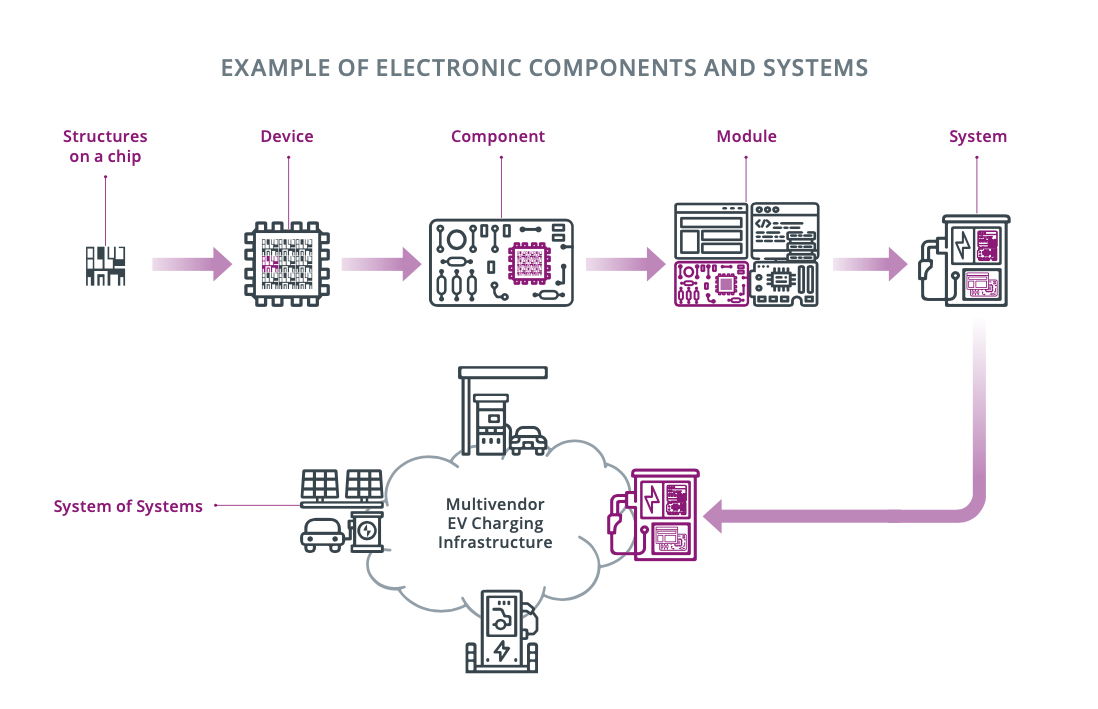
Figure 0.3 Different integration levels illustrated by the example of an EV charging infrastructure12 (Source: Eurotech)
Designing such artefacts requires an interdisciplinary hierarchical approach, whereby various ECS specialists are working at different abstraction levels. As a result, the same term can have different meanings for specialists of different ECS domains: for instance, a “system” designed and implemented within a given development process may be integrated as a “component” into a higher-level “system” within another development step of the engineering process. Nevertheless, to avoid confusion, since 2021 the ECS SRIA includes a glossary, where many of the key terms are defined, to avoid inconsistency across the various chapters. It was also felt that developing a common language was important in building a strong and integrated ECS community. In addition, some of the bricks of the ECS technology “stack” are further detailed below.
Device: in the context of the ECS SRIA, and if it is not further qualified, a device will be defined as a “packaged chip”, whether it is a packaged integrated circuit (e.g. system on a chip, memory, processor, or microcontroller) or a micro-electromechanical system (MEMS)/micro-opto-electro-mechanical system (MOEMS). A device performs a general electrical, electronic or electrical/electronic/physical transduction role.
Component: a combination of devices and other elements (such as passives) that fulfil a specific need, such as transduction of a single physical parameter within a well-specified case. A component is not self-contained in all its functions, as it requires the close support of other components for operation (e.g. in data processing, power handling, and embedded software).
Module: a combination of correctly integrated components in which their assembly embodies a specific functionality required for the proper working of a system (e.g. sensing and actuation module, control module, communication module, energy provision module). A module is self-contained in hardware and software, making it interchangeable between systems, and allowing a higher abstraction level in systems design.
System: for the purpose of this SRIA, a system is a set of electronic-based constituents (subsystems, modules and components, realised in hardware, software, or both) that are integrated in a way that allows the system to perform a desired (set of) function(s). Due to ECS typically being constructed hierarchically, a “module” (e.g. camera or other sensor) being part of the electronic “system” in an autonomous car might itself be referred to as a “system” when being designed (e.g. while integrating lower-level components together to achieve the “camera” function).
System-of-systems (SoS): a collection of independent and distributed embedded and cyber-physical systems dynamically composed to generate a new and more complex system, provided with new functionalities and driven by new goals not present in the constituent embedded and cyber-physical systems individually. The difference between a “system” (comprising subsystems, modules and components) and a “system-of-systems” (also comprising subsystems) is that the subsystems of a system are chosen and integrated during design-time (i.e. completely under the control of the engineers), while in a system-of-systems the constituent (sub)systems are physically independent and dynamically form a system-of-systems at run-time.
0.2.2 The structure
The first part of the ECS SRIA is composed of four chapters focused on the Foundational Technology Layers and their technical challenges along the technology stack, from materials and process technology to components, modules and their integration into electronic systems, embedded software developments and software technologies, to full systems and systems-of-systems. These foundational layers are characterised by hierarchical dependencies due to the inherent nature of ECS and the way they compose and integrate in complex structures. Advances in all Foundational Technology Layers will be essential to creating new electronic chips, components, modules, systems, and systems-of-systems along the value chain: these are the fundamental elements required to build the digitalisation solutions of the future.
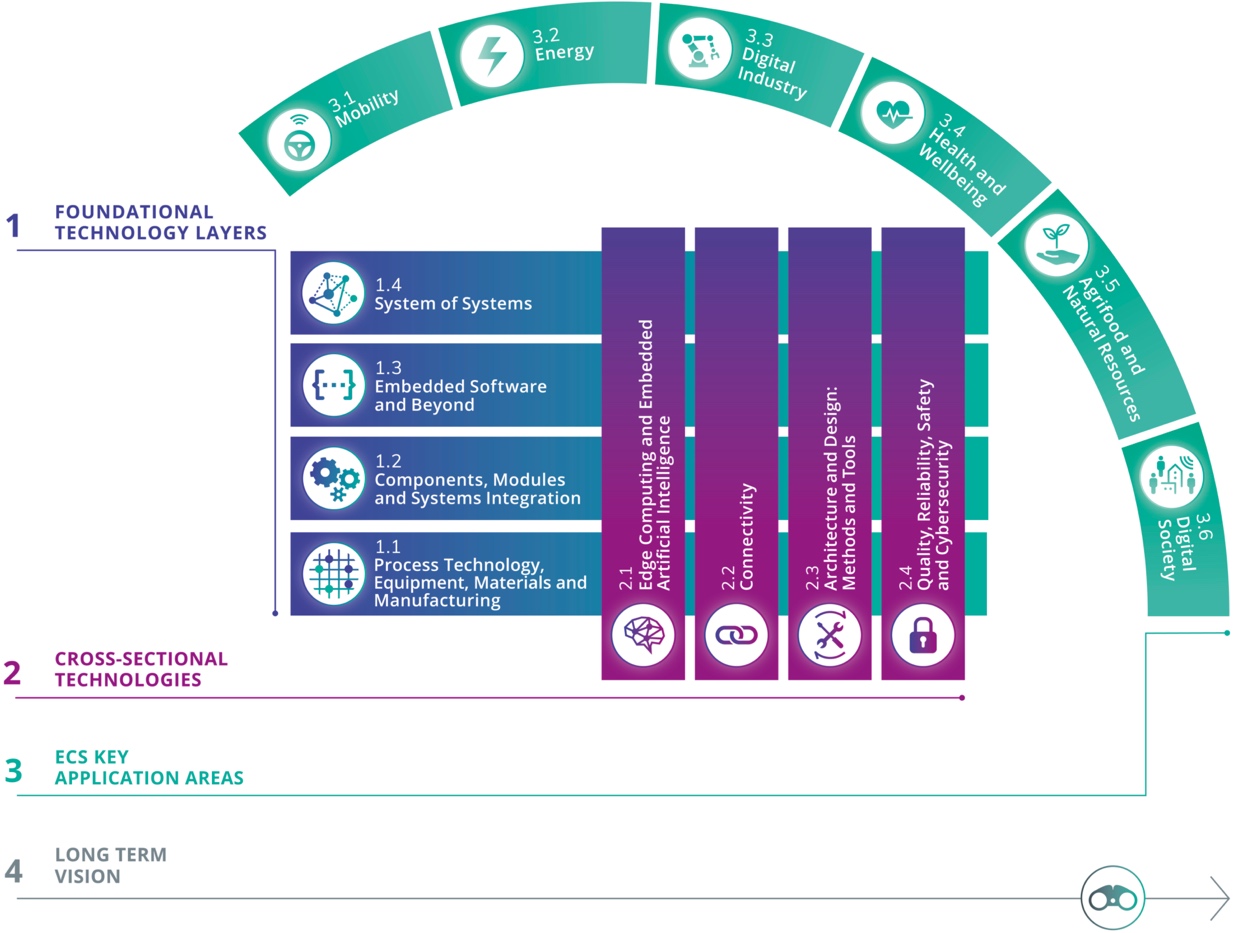
Figure 0.4 The structure of the ECS SRIA
The four Cross-Sectional Technology chapters address capabilities that span the foundational layers. Edge Computing and Embedded Artificial Intelligence now operate within a continuum from deep-edge devices and edge systems to on-premise resources and cloud or high-performance computing (HPC). The ECS focus is on hardware/software co-design, workload placement, connectivity and trustworthiness across that continuum; high-end computing infrastructure itself remains outside the ECS scope. Architectures and Design: Methods and Tools, together with Quality, Reliability, Safety and Cybersecurity, provide lifecycle-wide engineering methods across the stack.
The innovation generated by these cross-sectional technologies will be applied across foundational layer stacks and amplify the effect of innovation in all key ECS application domains. Of course, there is some overlap among the eight technology chapters since they are closely linked, but as they examine the individual challenges from different perspectives, this overlap is extremely constructive and generates valuable synergies.
In the third part of the ECS SRIA, six Application chapters describe the challenges arising from specific ECS application domains that are key for Europe and identify the RD&I efforts required by these application domains as regards ECS.
Finally, the Long-Term Vision chapter illustrates our vision of the ECS beyond the time horizon covered by the other chapters. It seeks to identify the research subjects that must be addressed at low TRL levels as foundation and preparation for the crucial developments in European industry over the next decade. Based on the trends and plans described in the preceding chapters, the long-term industrial requirements are also examined to help research programmes understand which hardware, software and system solutions should be produced most effectively for the continuous improvement of European digital technology.
As for previous editions, the chapter editing teams have been reviewing their text with the goal to achieve greater conciseness, while of course eliminating outdated materials and providing new data.
0.2.3 The ECS SRIA and its position in the technology landscape
Electronics components and systems are key digital technologies enabling the development of numerous applications. As such, the ECS research and innovation priorities are significantly driven by application roadmaps and needs. To that effect, the Key Application Areas part of the ECS SRIA translates application roadmaps into requirements for ECS. Conversely, the Foundational Technology Layers part maps out future advances and potential new breakthroughs in applications. The ECS SRIA therefore promotes synergies with many neighbouring application-oriented communities. For example, the Mobility Chapter (3.1) has strong links with ERTRAC; the Digital Industry Chapter (3.3) with EFFRA; and the Agrifood and Natural Resources Chapter (3.5) with the working group of the Alliance for the Internet of Things Innovation (AIOTI) in Smart Farming and Food Security, and with Water Europe13. In each case, experts participated in the work of both groups. There are also close interactions and alignments with European PPP initiatives, such as 2Zero and CCAM, IHI, etc.
The Cross-Sectional Technologies part also leverages the links of the ECS community with other technology-oriented domains, such as the European Technology Platform for High Performance Computing (ETP4HPC), EuroHPC, the European Working Group on High-Performance RISC-V based reference processing architectures, and Big Data Value Association (BDVA), with strong relations with the Edge Computing and Embedded Artificial Intelligence Chapter (2.1). Likewise, the Connectivity Chapter (2.2) benefited from fruitful exchanges with the 6G Infrastructure Association, SNS and inputs from the European Cyber Security Organisation (ECSO), as reflected in Chapter 2.4.
Several contributors of the Technology parts are also actively involved in the elaboration of international roadmaps (e.g. the Heterogeneous Integration Roadmap (HIR)14 in electronic packaging and integration, the IEEE International Roadmap for Devices and Systems (IRDS)15 for the semiconductor industry), and the RISC-V Roadmap of RISC-V International16 and the European Working Group17.
To summarise, this ECS SRIA combines application-pull and technology-push with the objective of enhancing the fertile dialogue between technologists and technology users, and strives to include discussions of upcoming strategic value chains.
0.2.4 New and growing trends
This revision focuses on technology developments that create clear ECS research bottlenecks across several chapters. The main shifts concern efficient artificial intelligence across the computing continuum, advanced and heterogeneous integration, optical and electrical interconnects, trusted open hardware, next-generation connectivity and dependable autonomous systems. Quantum technologies and beyond-CMOS concepts remain important, with maturity and time-to-application varying significantly by technology. The following sections therefore emphasise remaining ECS research needs rather than general technology descriptions.
A Chiplets
Chiplets are reusable integrated-circuit blocks designed to operate together within a package. They allow functions to use the semiconductor technology best suited to each function and then be combined through high-density interconnects.
Chiplet architectures can improve system economics and development flexibility by partitioning large designs into smaller dies, reusing validated IP and selecting the most suitable process technology for each function.1819
For Europe, chiplets provide an opportunity to combine strengths in specialised semiconductors, photonics, sensing, power electronics, packaging and system integration within heterogeneous multi-die systems. Open interfaces and interoperable design and test flows are therefore important if chiplets are to develop from supplier-specific implementations into broader multi-vendor ecosystems.
The research focus is shifting from basic feasibility towards interoperable, trustworthy and economically viable multi-die systems.
Key bottlenecks are die-to-die interfaces and multi-vendor interoperability, known-good-die and test strategies, power delivery and thermal management, 2.5D/3D integration, system-level Electronic Design Automation (EDA), verification and validation (V&V), and security.
These issues link packaging and integration to architecture, software, connectivity and lifecycle engineering.
Chiplets manufacturing is addressed in Ch 1.2, while implications of chiplets are addressed in Ch 1.3, 1.4, 2.2 and 2.3.
B Open-Source Hardware
Open-source hardware is hardware whose design is made publicly available so that anyone can study, modify, and further distribute the design, and/or freely make and sell hardware based on that design. The use of open-source hardware drastically lowers the barrier to design innovative SoCs. Indeed, this allows research centers and companies to focus their R&D effort on innovation, leveraging an ecosystem of pre-validated IP that can be freely assembled, modified, and customized for specific applications, whereas currently the cost of design of a set of IPs in-house is available to only few companies. And the use of alternative 3rd party IPs licensed by companies imposes constraints on innovation due to architecture. Open-source is also a sovereignty tool and avoids licensing IPs from foreign third parties, in a geopolitical context characterised by trade wars and export control restrictions.
Open-source hardware and RISC-V have moved beyond an academic trend. The main European challenge is its use for industrialisation: trusted and maintained intellectual property, coherent development tools and software, long-term governance, verification and certification.
This is particularly important when open hardware enters automotive, industrial, space and other safety- or security-critical products. Open ecosystems need documentation, testing, configuration control and product-lifecycle maintenance in addition to reusable intellectual property blocks.
The European strategy on open-source hardware should focus on application domains where there is a stronger impact, i.e. automotive, industrial automation, communications, health and aeronautics/defense. As these fields convey specific requirements (safety, security, reliability, power and communication efficiency…), the key differentiator between European core design efforts and existing players will be the attention given to the aforementioned requirements and also the extensibility with custom operations. Above all, a special focus should be placed on safety and security solutions, dealing with key aspects of collaboration, documentation, verification and certification in open-source communities.
A working group gathering European stakeholders was established in 2022. It drafted a technological roadmap starting with processors (RISC-V, beyond RISC-V, ultra-low power and high-end). The chiplet-based approach mentioned above is identified by the roadmap as a unique opportunity to leverage European technologies and foundries to create European HW accelerators interposers that could foster European More-than-More technology developments. Die-to-Die communication remains a missing link to leverage that approach, and its development in open-source is advocated by the working group.
The SRIA therefore treats open hardware as an ecosystem challenge spanning architecture, Electronic Design Automation, software, verification, certification and productisation. Open building blocks create value when they can be maintained and integrated into dependable industrial products.
C Quantum Technologies
Disruptive technologies, where market positions are not established yet, are level-playing fields where Europe has all its chances to gain leadership. Quantum technologies fall in that category and therefore their evolution and maturity are closely monitored by the ECS SRIA expert community. The importance of the technologies is identified in both the Chips Act and in the European Quantum strategy20. Together with the European Quantum Flagship SRIA, these documents highlight areas of importance and overlap with the ECS SRIA:
Technologies for dedicated quantum chips, required to fulfil the quantum challenges.
Classical chips technologies for quantum (enabling technologies) required to support the industrialization and scaling of quantum technology.
Systems combining these two for applications taking advantage of quantum technology.
Quantum technologies are very diverse in nature, encompassing quantum computing and simulation, quantum communication, and quantum sensing and metrology21. As application fields, they go beyond the scope of the ECS SRIA, but the community should prepare for using quantum technology in the applications that can benefit from quantum chip technologies, e.g. in navigation and timing using quantum sensors.
Quantum chip technologies include six major modalities: Superconducting circuits, semiconducting quantum dots, ion traps, photonics, neutral atoms and nitrogen vacancies in diamonds. All of these technologies have their specific chip technology development needs. The technologies combine traditional microfabrication technologies in Silicon and other substrates with novel primitives that use quantum physics on single electron/atom/ wavefunction level, with RF and optical control and readout. As an example, ion trap quantum systems combine RF electrodes for ion trapping for with optical control of trapped ions.
Quantum technologies use have special material needs, such as the use of isotopically pure Si, and specific processing needs, such as Al/AlOx/Al tunnel junctions with extreme requirements for dielectric tunnel barrier quality and thickness control. In integrated photonics, the needs of the quantum systems typically include extremely low losses and wavelengths in the visible range, from 800-900 nm as low as 300-400 nm, depending on the atoms or ions used.
The maturity of quantum technologies differs substantially. Quantum sensing is already closer to deployment in selected applications, including navigation, timing and biomagnetic measurements. Large-scale fault-tolerant quantum computing remains a longer-term objective.22 For ECS, this makes enabling hardware and manufacturing capabilities more relevant than a single market forecast.
Across these maturity levels, the main ECS bottlenecks are process control and material quality, metrology, low-loss photonics, cryogenic electronics, control and read-out, reliable fabrication, interconnect and packaging:
As there are still several candidates for becoming the standard quantum computing technology, a wide range of materials is relevant, together with innovations in process technology.
New metrology capabilities are required, especially the measurement of electrical properties, such as local carrier mobility.
To achieve practical applications, reliable fabrication, connection, and read-out of qubits need to be developed.
The low temperatures, from milliKelvins to 4 K, at which many quantum systems are operated requires the development of cryogenic devices, to interface conventional electronics.
These maturity differences lead to quantum technologies remaining visible in the SRIA while placing most quantum-computing developments in the Long-Term Vision. Nearer-term enabling technologies remain linked to the relevant foundational chapters, in particular process technology, photonics, packaging, sensing and control electronics.
D Spintronics
Similarly to quantum technologies, spintronics (excluding MRAMs which are already at a commercial stage) belongs to the category of disruptive technologies, where market positions are not established yet and Europe has the opportunity to gain leadership. This is an emerging field that holds significant potential to become a key component of future energy efficient chips technologies. The high performance and ultra-low power consumption intrinsic of such technology, make it a very attractive solution to the increasing demands for computing power, notably with the growing market of AI. By combining processing, logic, sensing and storage on a unified platform, spintronic devices can advance technologies such as neuromorphic electronics, unconventional and quantum computing, and energy harvesting, significantly contributing to low-carbon footprint prospects. Europe is well positioned with world-leading institutes in the domain.
E Silicon Photonics
The growth of artificial intelligence, data-centre traffic and high-performance computing is raising bandwidth and energy requirements for interconnects. Photonic integration is therefore moving from long-haul and rack-level communication towards intra-datacentre, chip-to-chip and optical input/output links, where electrical interconnects face power and bandwidth limits.
Silicon Photonic Integrated Circuits (PIC), referred to as Si-photonics, is the technology that realizes photonic components and circuits on Si substrates using materials and fabrication process flows in the well-established microelectronic industry. Replacing electrons with photons to transmit data brings advantages including high-speed operation, low power consumption and high-capacity transmission. Building photonic integrated circuits (PICs) based on industry-standard Si platform promises additional merits, namely lower cost, high-volume manufacturing, large integration density, advanced functionality and high scalability.
Furthermore, Si-photonics, with their CMOS compatibility and small size, weight, area, and power consumption, have the capability of accommodating growing volumes of computer data arriving in real time and at very high rates in large-scale distributed computing systems. The wavelength and spatial multiplexing properties of optics are beneficially translatable to executing critical bandwidth and communications-intensive connections between increasingly parallel computational resources.
Benefiting from an ideal Si/SiO2 interface and a large refractive index contrast, Si is an ideal platform for implementing passive optical devices such as low-loss waveguides, mode converters, and multiplexers/demultiplexers. Although Si is a centrosymmetric crystal and, thus, not an ideal material for optical modulators, high-performance modulators have been demonstrated. Efficient Ge- and SiGe-based photodetectors operating in the telecom bands are also selectively grown on Si-photonics wafers.
However, if Si can efficiently transmit, modulate, and detect light, its indirect band structure precludes efficient light emission. The achievement of on-chip light sources, using Ge alloys for instance, represents a significant challenge in advancing the complete integration of silicon-based PICs. Therefore, III-V material (InP, GaAs) on-chip lasers are currently embedded in PICs using 2.5 and 3D heterogeneous integration. Monolithic integration of III-V materials is an attractive alternative due to its high integration density. However, it introduces a high density of crystalline defects, significantly degrading the laser’s performance. Exploring methods of reducing these defects is paramount to advance monolithic integration toward high-density, large-scale silicon-photonic integration.
Similarly, for applications that require high-speed modulation, the properties of Si-based modulators are not sufficient. Hence, ferroelectric electro-optic materials such as, III-V semiconductors, LiNbO3 and BaTiO3 should be embedded in the PIC using heterogeneous integration (die-to-die, die-to-wafer, or wafer-to-wafer bonding). Also, improving the quality and performance of waveguides, passive and active photonics devices sometimes requires the introduction other dielectric materials such as nitrides.
Europe has strong capabilities across photonics research and the photonic integrated circuit value chain, while scaling manufacturing, high-volume packaging and integrated design workflows remains a challenge. For ECS, optical input/output, co-packaged optics and photonic interposers connect photonics directly to advanced packaging and AI infrastructure. Heterogeneous electronic-photonic integration and manufacturable optical packaging are central R&D needs. Sensing, LiDAR, quantum, biomedical and environmental applications remain important and broaden the required materials and wavelength range.
F Artificial intelligence topics in the ECS SRIA
Artificial intelligence now affects ECS in three closely related ways: AI runs inside embedded and cyber-physical systems; ECS hardware determines the efficiency of AI from the edge to large computing infrastructure; and AI is entering ECS engineering itself.
ECS as enabler of AI: Embedded and edge AI are moving across the deep-edge, edge and on-premise parts of the computing continuum. Agentic and smaller specialised models extend the range of local functions. The central bottlenecks are energy and memory efficiency, data movement, real-time performance, privacy, safety, security and the ability to update systems over long lifetimes.
AI as enabler of ECS: AI can support design-space exploration, software generation, verification and validation, test generation and lifecycle operations. These tools can improve engineering productivity, but their output still requires traceability, verification and domain-specific assurance, especially for safety- or security-critical systems.
Trustworthy AI in ECS is a system-level engineering problem. Research must address predictable behaviour, monitoring and fallback strategies, secure updates, training and validation data, and the interaction between learning components and conventional control functions.
Finally, a purely technical approach to develop trustworthy and explainable AI, or having AI in the loop with verification of its results might not be enough to address the growing public concerns about the potential dangers of AI (pushing many governments across the world to sign the Bletchley Declaration on AI safety). In the years to come, cooperation between multidisciplinary partners with backgrounds in AI, ECS and social sciences, as well as access to “foundation models” by European academia and industry will be required to achieve and ensure the acceptance of efficient and responsible AI-based ECS, reflecting European values at the same time as reaping the benefits of European AI.
These challenges connect Chapters 1.1, 1.3, 2.1, 2.3 and 2.4. Together they cover efficient AI hardware, embedded and agentic AI, AI-assisted engineering, and the verification and assurance methods needed for dependable deployment.
0.3.3.1 G Physical AI and autonomous systems
Physical AI brings artificial intelligence into robots and autonomous machines that perceive, reason and act in the physical world. The ECS research challenge is the closed loop from multimodal sensing through embedded or edge inference and real-time control to actuation, with dependable connectivity, energy efficiency, functional safety and verification and validation. Progress therefore depends on coordinated advances across sensors, compute, software, connectivity, power electronics and systems engineering, enabling new autonomous products and applications across the SRIA domains.
0.3.3.2 H Managing the energy demand – transition and AI
Electrification of mobility and industry, expansion of renewable generation and the growth of AI infrastructure are changing both electricity demand and power-system operation. AI infrastructure is now a distinct ECS demand driver because accelerators, high-bandwidth memory and large distributed computing systems raise requirements for logic, memory, interconnect, packaging and power electronics.
The system bottleneck is no longer only compute performance. Data movement and power delivery are becoming equally important. High-bandwidth electrical and optical interconnects, 2.5D/3D integration and advanced packaging reduce communication distances, while efficient power conversion must move closer to the point of load and remain within thermal and reliability limits.
Global data-centre electricity consumption is projected to roughly double from about 485 TWh in 2025 to around 950 TWh in 203023, with AI-focused data centres growing much faster than the total. This makes power conversion, cooling, grid integration and energy-efficient computing key ECS challenges. Wide-bandgap semiconductors, including silicon carbide (SiC) and gallium nitride (GaN), are important for efficient power conversion in data centres as well as mobility, renewable energy and industrial systems. This creates a common research agenda around device technology, packaging, thermal management, reliability and power-system control.
AI infrastructure also interacts directly with the energy system. Large computing sites need efficient and controllable power supply, while grid constraints and variable renewable generation increase the value of monitoring, forecasting and control. Europe has relevant strengths in power electronics, semiconductor equipment, advanced integration and system engineering. To keep the technology base in Europe and serve demand from European manufacturing, continued research and investment in the key technologies for future electricity demand are essential.
Device architecture, the excellence in achieving extremely thin wafer thicknesses, and for the wide bandgap technologies the move to larger wafer diameters are core technology capabilities in Europe which should be further strengthened to keep a significant manufacturing and knowledge share in Europe. Vision is to serve the energy transition with highest efficient, reliable, sustainable manufactured power electronics and be capable to have the system competence to design beyond state-of-the-art power systems, for the renewables, electric mobility and for the powering of the AI data centers.
0.2.5 Further changes vs. previous edition
On top of these general trends, individual chapters also reflect the latest evolutions:
In Chapter 1.1, Process Technology, Equipment, Materials and Manufacturing, AI-related semiconductor technologies are strengthened across advanced computing, manufacturing and packaging, including AI-chip assembly and test. Spintronics is positioned more clearly across computing and sensing, while sustainability now explicitly addresses PFAS and other hazardous materials.
In Chapter 1.2, Components, Modules and Systems Integration, the three Major Challenges are retained, while advanced integration expands toward integrated photonics, co-packaged optics and flexible electronics, with stronger lifecycle sustainability.
Chapter 1.3, Embedded Software and Beyond, extends agentic AI from an engineering aid to a deployed software component. This adds requirements for secure integration, continuous monitoring and verification, lifecycle traceability, and resilience against model and software-supply-chain vulnerabilities.
In Chapter 1.4, System of Systems, runtime trustworthiness is strengthened by adding stability alongside safety and security. The revision also gives more weight to energy-aware distributed intelligence, autonomous operation and lifecycle management across edge-to-cloud infrastructures.
Chapter 2.1, Edge Computing and Embedded Artificial Intelligence, updates the fast-moving edge-AI landscape with small generative models, tighter memory constraints and embodied AI, while retaining its four Major Challenges.
Chapter 2.2, Connectivity, strengthens secure connectivity for Physical AI and European-controlled end-user devices, including low-latency, Integrated Sensing and Communication and quantum-safe requirements.
Chapter 2.3, Architecture and Design: Methods and Tools, strengthens AI-supported engineering across the lifecycle, moving towards agentic orchestration of design and verification while extending Digital Threads across the value chain.
Chapter 2.4, Quality, Reliability, Safety and Cybersecurity, separates hardware quality and reliability into distinct Major Challenges, raising the total to six, and updates cybersecurity and AI-safety requirements around current EU regulation.
Chapter 3.1, Mobility, is restructured more strongly around the Software-Defined Vehicle as an integrated European hardware–software platform. New emphasis is placed on strategic autonomy, reusable open software building blocks, hardware abstraction and virtualisation, and AI-supported verification and validation across the vehicle lifecycle.
Chapter 3.2, Energy, receives a focused update on energy-system resilience and the AI–energy nexus. It adds energy-autonomous sensing with embedded intelligence and reflects AI’s growing electricity demand and optimisation potential.
Chapter 3.3, Digital Industry, strengthens autonomous systems and robotics around Physical AI and robot foundation models. It adds the transition of advanced and anthropomorphic robots towards industrial deployment and frames European capability across the complete robot stack as a strategic sovereignty issue.
Chapter 3.4, Health & Wellbeing, shifts towards reusable ECS architectures and reference designs across distinct medical devices. It also strengthens multimodal sensing, digital twins, edge-enabled home care and emerging Bio-IT technologies.
Chapter 3.5, Agrifood & Natural Resources, is substantially refocused around climate change as a present operating condition for agriculture and ecosystems. The technology update strengthens AI-supported decision-making and adds Physical and embodied AI for robots, autonomous machines and drones acting directly in the environment.
Finally, Chapter 3.6, Digital Society, extends its ECS scope in two directions: distributed digital content-production workflows and financial infrastructure. It also strengthens consumer cybersecurity against fraud and identity attacks, linking trustworthy digital services more directly to European technology capability.
0.2.6 The ECS global timeline for Europe
The 2027 ECS SRIA uses three planning horizons: short term (2027–2031), medium term (2032–2036) and long term (2037 and beyond). The horizons indicate when the chapters expect research results to reach advanced prototype or early commercialisation levels, while recognising that maturity differs by technology and application.
The following figures summarise the most salient milestones to be reached in the various domains covered by the ECS SRIA over the three time periods:
Short term (2027–2031)
Priorities are tied to technologies and engineering capabilities already approaching industrial validation or deployment.
Medium term (2032–2036)
Roadmaps remain sufficiently mature to identify expected capabilities, but technology choices and application requirements may still change.
Long term (2037 and beyond)
Milestones are prospective and indicate research directions rather than fixed deployment dates.
Including a milestone in each of these time periods means that the described features are expected to be available at TRL levels 8–9 (prototype or early commercialisation) within that timeframe. For example, the Components, Modules and Systems Integration Chapter expects that, within the next five years (short term), the materials that enable recycling and repair will be available. These materials will allow for the deployment of the monitoring of forests, fields and oceans, as envisioned by the Agrifood and Natural Resources Chapter over the same time horizon. In parallel, this monitoring will gain in efficiency due to the development of advanced AI edge solutions leveraging open source or alternative strategies, as forecast by the Chapter on Edge Computing and Embedded Artificial Intelligence.
Detailed timelines are maintained in the individual chapters, where assumptions and maturity can be updated with the required technical context. The Introduction therefore concentrates on the shared horizons and the dependencies between them.
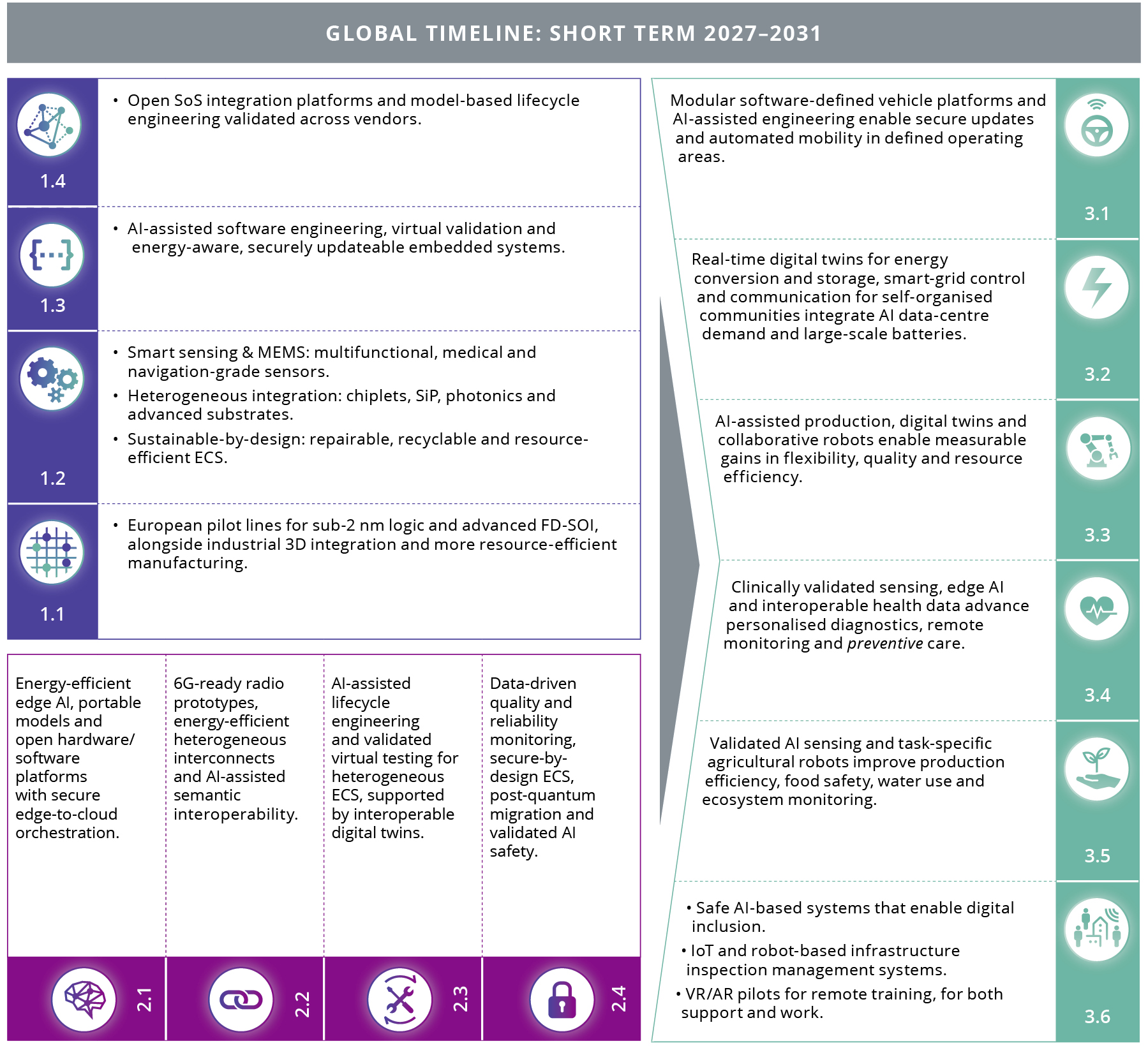
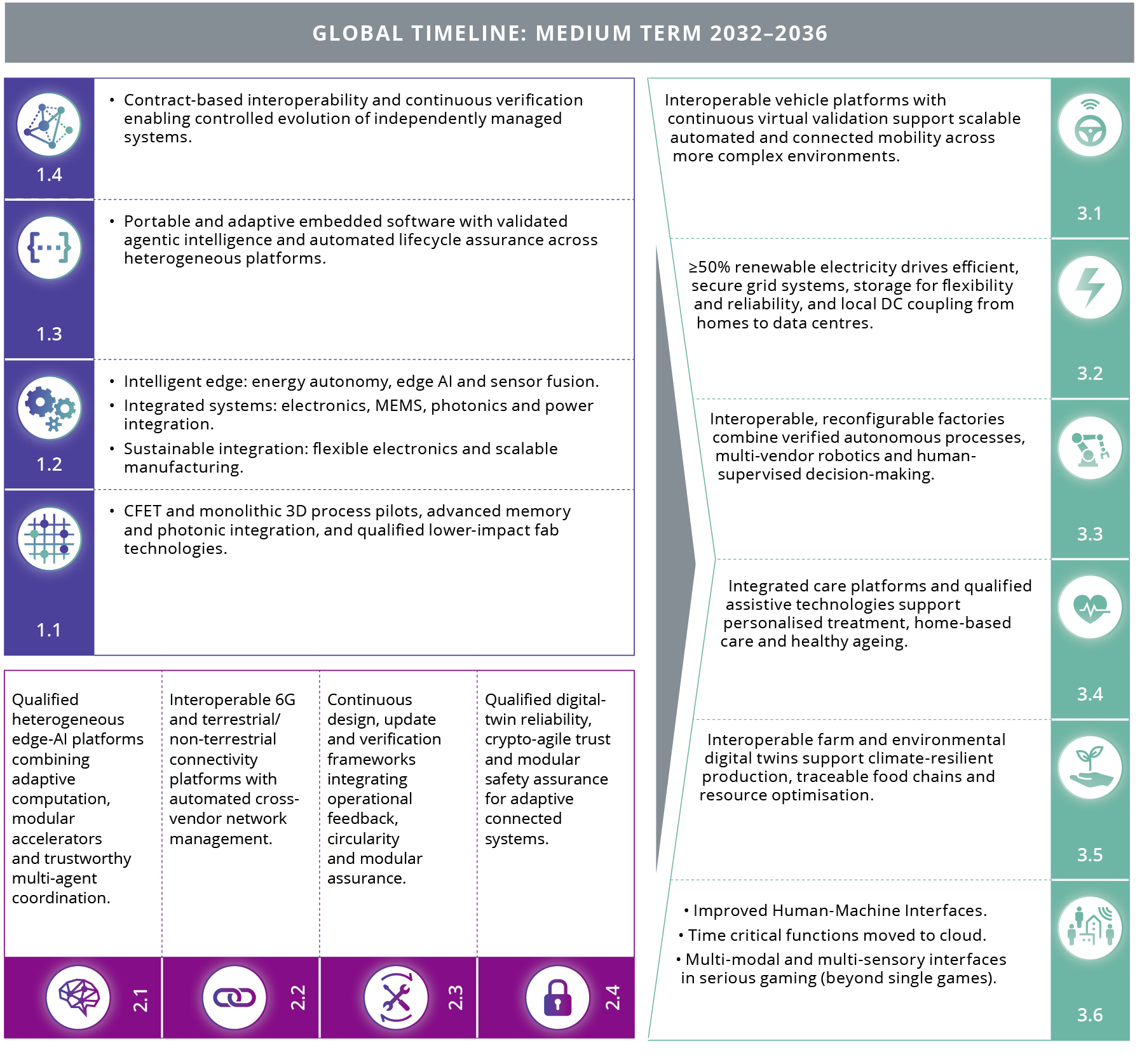
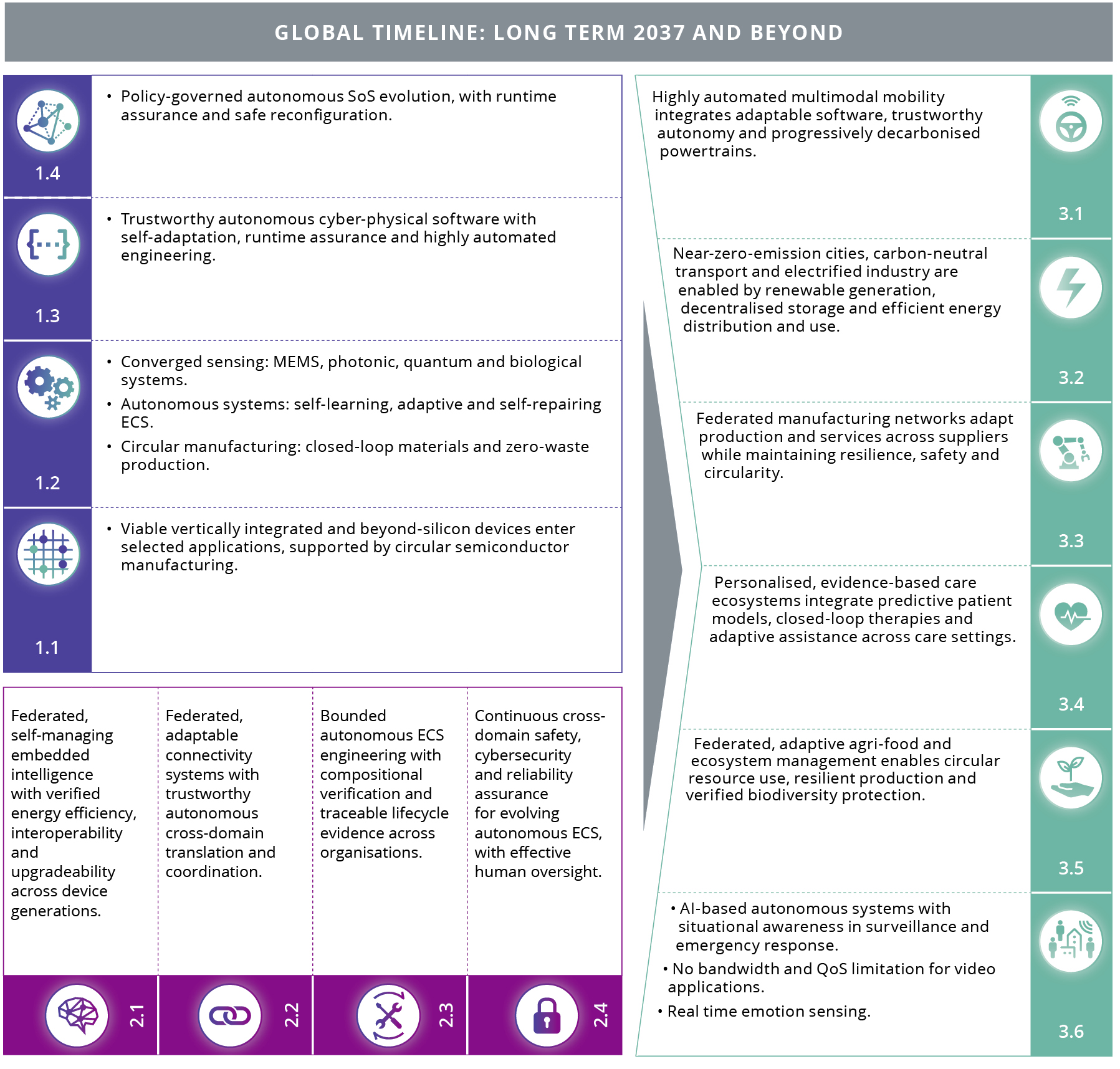
0.2.7 The ECS SRIA outline
The following diagram provides an outline of the entire ECS SRIA to clarify the roles of the chapters, the technology domains they cover and the synergies between them, simplifying the comprehension of the ECS SRIA and its “navigation”.
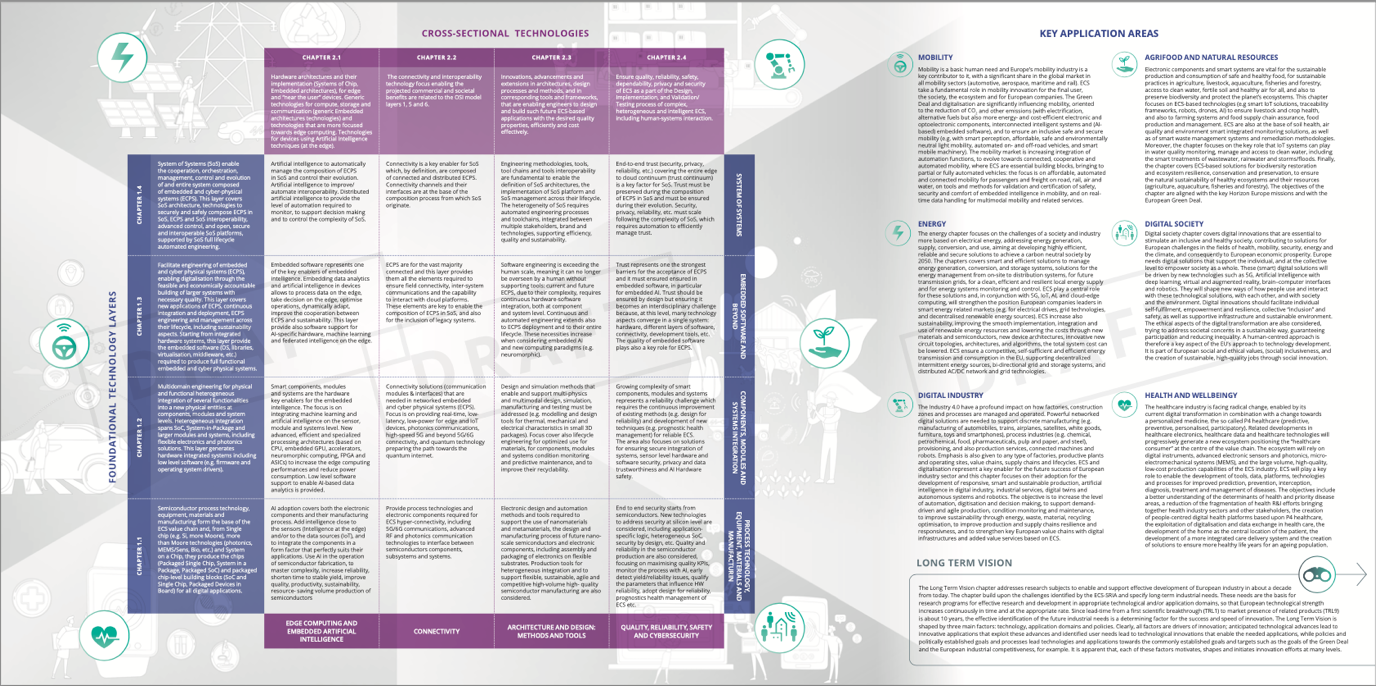
0.3 PART 3 - HOW? Navigating the ECS SRIA
As mentioned, the ECS covered by this document is very wide-ranging, and involves many technical disciplines in materials, processes, hardware and software. Therefore, most readers will only want to read those chapters that cover the disciplines of their interest, without being willing to go through all the technical details presented in the ECS SRIA.
For each technology and application domain it covers, the ECS SRIA identifies specific so-called Major Challenges, with a focus on the most critical aspects to be tackled from the perspective of innovation. The analysis of each Major Challenge illustrates the state of the art of the associated technology and/or application domains, describes the vision of the ECS community for the future, identifies potential outcomes, and defines research and engineering activities on the key focus areas that are fundamental to successfully address the challenge.
The structure of all the Foundational Technology and Cross-Sectional chapters is identical. In the Key Application Areas chapters, the authors explore each domain with the application demands as the main focus, not the technical challenges.
A Glossary describing the terms used in the document, as well as a List of Acronyms used in the document, can be found in the Appendix. The Analytical Index available in earlier releases of the ECS SRIA is now substituted by an advanced Search functionality. At the end, the reader can also find a List of Contributors who collectively wrote this ECS SRIA.
Finally, to highlight the synergies/links between the chapters and provide hints to the reader, cross-references have been introduced alongside the text.
Cross-references consist of the Chapter icon and appear alongside the text. When hovered on, they indicate the relevant chapter number and the topic or concept described in the text is also highlighted. When clicked on, they will navigate you to the referenced Chapter.
References within a text are indicated by small numerical markers embedded in the content, e.g. Upon clicking one of these markers, readers are instantly directed to the corresponding entry within the References section. This feature allows readers to seamlessly access the sources from which the information has been derived.
Furthermore, by clicking on the same footnote number located in the References section, readers can effortlessly return to the exact point within the main text where the reference was initially cited. This interactive function not only enhances the reader's comprehension but also streamlines the process of verifying and exploring the sources behind the presented information.
https://ec.europa.eu/digital-single-market/en/policies/building-european-data-economy↩︎
https://eur-lex.europa.eu/legal-content/en/TXT/?uri=CELEX:52021DC0118↩︎
A collection of independent and distributed embedded and cyber-physical systems dynamically composed to generate a new and more complex system, provided with new functionalities and driven by new goals not present in the constituent embedded and cyber-physical systems individually. See full definition in the glossary↩︎
From Internet of Things to System of Systems – Market analysis, achievements, positioning and future vision of the ECS community on IoT and SoS, P. Azzoni, Artemis 2020.↩︎
An integration platform is an ECS allowing the integration of different systems, applications and services into a single system. See full definition in the glossary↩︎
Semicon Coalition calls for reinforced Chips Act | Shaping Europe’s digital future↩︎
Europe’s Digital Decade: digital targets for 2030 | European Commission (europa.eu)↩︎
Pact for Skills - Employment, Social Affairs & Inclusion - European Commission (europa.eu) Pact for Skills - Employment, Social Affairs & Inclusion - European Commission (europa.eu)↩︎
More than 81% of produced software are consuming open-source code in products or services (https://github.com/todogroup/osposurvey/tree/main/2020)↩︎
PFAS is a class of thousands of synthetic substances known as ‘forever chemicals’ since they do not break down in the environment. PFAS offer a unique set of technical characteristics, which include exceptional heat and chemical resistance, high electrical insulation resistance, high purity, low-outgassing and low coefficient of friction↩︎
Structure on a chip: elementary building blocks of an integrated circuit, such as a FDSOI or FinFET transistor, or more complex structures such as an embedded memory block.↩︎
https://watereurope.eu/wp-content/ uploads/2019/07/Water-Europe-SIRA.pdf↩︎
https://eps.ieee.org/technology/ heterogeneous-integration-roadmap/2019- edition.html↩︎
https://irds.ieee.org/↩︎
https://digital-strategy.ec.europa.eu/en/library/recommendations-and-roadmap-european-sovereignty-open-source-hardware-software-and-risc-v↩︎
John Lau, Chiplet Design and Heterogeneous Integration Packaging, Springer 2024↩︎
Cadence PCB solutions, https://resources.pcb.cadence.com/blog/2023-all-about-chiplet-technology, consulted 25 July 2024↩︎
Quantum Europe Strategy: Quantum Europe in a Changing World, COM(2025) 363 final, European Commission↩︎
Strategy Research and Industry Agenda, Published in February 2024 by the European Quantum Flagship↩︎
McKinsey & Company: Quantum Technology Monitor 2025↩︎
IEA (2026), Key Questions on Energy and AI, IEA, Paris https://www.iea.org/reports/key-questions-on-energy-and-ai, Licence: CC BY 4.0↩︎